


Lavender comes up a lot in cat-care conversations — usually with mixed messages. Some sources call it dangerous; others list it among calming herbs you can safely give your cat. Both are right; both are wrong; which one applies depends entirely on the form.
This is the breakdown of what's actually safe, what's not, how much is too much, and why the dried-versus-oil distinction is the only thing that really matters.
Why dried lavender is fine but essential oil is dangerous
The headline answer is simple: dried lavender is fine; lavender essential oil is not. And the reason isn't really about lavender — it's about concentration.
Lavender's main calming compound is linalool, a terpene that also shows up in basil, mint, citrus peels, and a lot of other plants. Dried lavender buds contain roughly 1–2% linalool by weight. Lavender essential oil contains 30–50%+. That's a 20-to-30-times difference, and it matters because cats are uniquely bad at processing concentrated terpenes.
Cats lack glucuronyl transferase — the liver enzyme most mammals use to break down compounds like linalool and clear them from the bloodstream. Humans, dogs, and most other pets process these in hours. In cats, the same chemical can hang around for days. Small doses metabolize fine. Concentrated doses build up and cause problems: GI upset, weakness, depression, and in worst cases liver stress.
So when you read "lavender is toxic to cats" online, what's almost always being measured is essential oil exposure — a cat licked a diffuser pad, inhaled a heavy diffused mist for hours, or had topical oil applied to its fur. Those are real risks. A pinch of dried lavender in a calming catnip blend doesn't behave the same way at all.
The practical rule: anything labeled essential oil, oil concentrate, or pure extract — keep it away from your cat. Anything labeled dried, dried flowers, or used in a low-percentage formulation — almost always fine. We'll get into specific amounts next.
What "in moderation" actually means
"Moderation" gets thrown around as if everyone knows what it means. Here's what it actually looks like in practice.
For a calming catnip blend (the kind you'd offer your cat as enrichment), the safe formulation cap is roughly 2% lavender or less by weight. Our calming blends with lavender stay well under that. That works out to less than a pinch of dried lavender in a 1/8-cup serving — trace exposure that delivers the calming scent without putting any real chemical load on your cat's system.
For loose dried lavender (the kind you might put in a sachet or in food), the answer is the same: a pinch at a time, not a handful. If your cat sniffs or licks a small amount, that's nothing to panic about. If they manage to chew through a pillow stuffed with pure dried lavender, call your vet — the volume matters more than the substance.
What "in moderation" doesn't mean:
- Lavender essential oil in any amount, applied or diffused
- Lavender hydrosol on the skin or in food (without your vet's guidance)
- Lavender supplements made for humans, regardless of size
- Cat treats listing lavender high in the ingredient list (more than ~5% by weight)
A reasonable upper bound for offering a lavender-containing calming blend: a few times a week, not daily. Even at safe doses, your cat doesn't need it constantly.
Do cats actually like lavender?
Most cats are neutral on lavender. It's not catnip. It doesn't trigger the rolling, head-rubbing response you get with nepetalactone (the chemical in catnip itself). Some cats are mildly attracted and will sniff or rub. Some are mildly avoidant. Most just don't care.
What we've noticed — and this is anecdotal, not a clinical claim — is that some cats settle down when there's a small amount of lavender in the environment. The calming effect of linalool on humans is reasonably well-documented (it's one of the reasons lavender shows up in sleep products). The mechanism is olfactory: scent → limbic system → calming signal. There's no obvious reason that pathway wouldn't work in cats, at least mildly.
That said: "some cats seem to like it" is not the same as "lavender works for every cat." In calming blends, the catnip is the active part. Lavender is a complement, not the engine. Cats that already love their calming blends might not even notice the lavender's there.
If you want to know what consistently does move cats sensorially, catnip bubbles are worth trying — they combine the catnip response with a visual chase, which is a different lever than scent alone.
How we use lavender in calming catnip blends
Our calming catnip blends with lavender (Mice Dreams, Pawty Mix, Lemongrass Pawty Mix) all keep the lavender content under 2% of the total weight. That's a deliberate ceiling, not a coincidence. The lavender is there to complement the catnip's effect with a familiar calming scent — not to do the work itself.
A few formulation principles we stick to:
- Dried only, never oils. Every gram of lavender in our blends is dried flower. We don't formulate with essential oils, hydrosols, or extracts. The dried form is forgiving — concentrated forms aren't.
- Lavender pairs, doesn't lead. It's mixed into blends that already contain catnip (and sometimes other supporting herbs). It's never the primary ingredient.
- Low ceiling, by weight. Under 2% is the rule across all our calming blends. The amount your cat is actually exposed to in a serving works out to less than a pinch.
That under-2% cap is why customers ask us, regularly, whether the lavender in our blends is safe — and the honest answer is that it's well below thresholds where lavender starts to be a problem for cats. If you want the chemistry on how catnip itself works (and why blending it with other herbs amplifies certain effects), our catnip guide covers the mechanism end of it.
Lavender-blend calming catnip
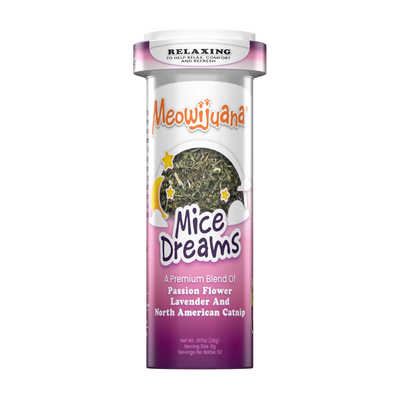

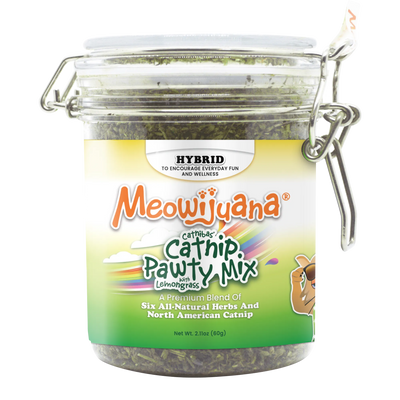
You can also browse the full lineup of calming, stimulating, and hybrid blends to see which fits your cat's profile.
Lavender plants and household products around the house
What about lavender in your home — the plant on the windowsill, the diffuser in the bedroom, the laundry sachet under the bed?
Live lavender plants. Generally fine. Cats occasionally nibble at houseplants, but lavender's strong scent makes it unappealing — most cats won't get into them enough to matter. If your cat does eat a larger amount, watch for GI upset.
Lavender essential oil diffusers. Avoid. Diffused essential oils put concentrated terpenes into the air for hours, and your cat is breathing them the entire time. Even the indirect exposure can be enough to cause symptoms in sensitive cats. This is the single biggest household lavender risk.
Lavender candles. Usually fine. The scent throw is much lower than a diffuser and the exposure is brief.
Lavender soap, detergent, sachets. Almost always fine. The concentration in finished products is low and your cat isn't ingesting it. Just keep sachets out of bedding your cat sleeps on for hours at a time.
Lavender hydrosol. Middle ground — much less concentrated than the oil, but more than dried. Don't apply to your cat or put it in food without your vet's guidance. Used as a room spray well away from the cat, low risk.
If you want a calming format that doesn't involve any lavender at all, silvervine sticks work through a completely different mechanism.
Signs your cat might be having a reaction
If your cat has been around lavender — especially essential oil or a larger amount of dried — and you're noticing any of these, call your vet:
- Drooling, vomiting, or diarrhea. Most common early signs. Usually GI upset from oral exposure.
- Unusual lethargy or weakness. Your cat isn't acting like themselves — sleeping more, less responsive, slow to move.
- Difficulty walking or wobbly coordination. A neurological sign. Treat this as urgent.
- Tremors or twitching. Rare but serious. Get to a vet now.
For trace exposure (cat brushed against a lavender plant; sniffed a sachet; ate a few grains from a low-percentage blend), there's almost never anything to do. Watch them for a few hours and they'll be normal.
For larger or concentrated exposure (essential oil on fur or licked from a diffuser pad; a pile of pure dried lavender consumed), call your vet — even if your cat seems fine right then. Symptoms can show up 6–12 hours later.
What to do if your cat ate lavender
If your cat ingested something with lavender in it, here's the order:
- Identify what they got into. Dried lavender? An essential oil? A hydrosol? A lavender-containing product like a candle, sachet, or blend? The form matters more than the substance.
- Estimate the amount. A few grains of a calming blend = trace. A few drops of essential oil = serious. The whole sachet = call now.
- Call. For essential oil ingestion in any amount, or for dried lavender ingestion in large quantity, call your vet or one of these poison hotlines:
- ASPCA Animal Poison Control: (888) 426-4435 (fee may apply)
- Pet Poison Helpline: (855) 764-7661 (fee may apply)
- Save the packaging. Whatever they ate, bring or photograph the label. Your vet needs to know the formulation.
For trace exposures, watch your cat for 6–12 hours. Most go right back to normal. For anything concentrated, don't wait.


3 comments
I was looking for a calming solution to my big gray cats anxiety. He’s sixteen pounds, I know, and everything I found today was either those pheromone plug ins which I don’t trust, and some kind of calming treat which was to be fed a treat per pound. Not going to work. I saw your product and rifled through until I found this particular blend. My cat LOVES IT. I can’t stress that enough. He’s normally sprinting around, slamming cabinet doors and acting a fool. But after he tried meowijuana and we played with his mouse for a bit, now he’s napping peacefully and not standing by my door squealing and squawking. I know exercise plays an important role, but normally he has so much nervous energy that I can play with him for hours and he still won’t be any calmer.
Thanks, meowijuana, from me and Asher! <3 you just made a lifelong customer.
I’ve bought blooming
Lavender plants. I just wonderrd if I should keep the 1 yof cat away.
The answer seems to be yes!!
Thank you very much.
Thank you so much for this post! Esp. the note at the end which gave me such relief to read.
I grew some lavender last year and had it tied in small bundles that were left to hang as they dried. Months later I finally am taking the bundles down and stripping the lavender leaves into a jar. That made a heck of a mess and sure as you would know it my two kitties ran for the crinkley sound of the dried plant. Whatever fell on the floor they were scarfing up like it was catnip. I smiled at first then ran to push them out into another room as I looked to the Internet to make sure it was ok for them to consume. That’s when I found your post.
Again, thank you for posting about the dried lavender. We’ll probably all take a nap later today!