


The Ingredient Behind Doggijuana
If you've come across Doggijuana products — the refillable toys, the calming treats, the botanical blends — you'll have seen the name Juananip® everywhere. It's the ingredient that makes Doggijuana work, and it raises an obvious question from most dog owners: what exactly is it, and why does it calm my dog?
This post answers both questions thoroughly — covering what Juananip is made from, the science behind how it affects the canine nervous system, how to use it, and what to expect.
What Is Juananip?
Juananip® is Doggijuana's proprietary botanical blend built on a foundation of 100% organic catnip (Nepeta cataria), grown in the USA and Canada. The standard Juananip bottle contains pure organic catnip. The enhanced Chamomile & Passion Flower blend adds two additional calming botanicals to the base. Juananip Bites — the treat format — add L-tryptophan and peanut butter to chamomile and catnip.
All forms are free from THC, CBD, artificial additives, and synthetic compounds. The name Juananip is a playful nod to the product's catnip origins and its effect on dogs — a state of relaxed, happy engagement Doggijuana calls doggi-vana.
Three ways to use Juananip®
Pick how you want to use it and we'll walk you through it.
- 1Open the toy pocketRemove any old herb from previous sessions.
- 2Add a pinch of Juananip®About 1/4 teaspoon. Less is more — a small amount is more interesting than an overwhelming one.
- 3Close the pocket and give it to your dogPresent it at nose level and let them investigate at their own pace. Don't push it toward them.
- 4Let them playSniffing, carrying, chewing, tossing — all good. Most dogs naturally disengage when the scent fades.
- 5Refill when interest dropsUsually after 2–5 sessions. Store the toy in an airtight bag with extra Juananip® between uses to extend the scent.
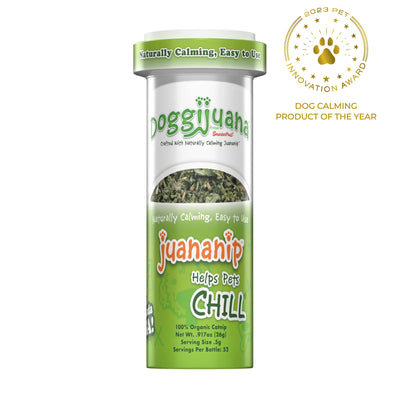
💡 Try the Chamomile & Passion Flower blend in the toy for extra calm during stressful periods.
- 1Prepare your dog's meal as normalWorks with wet food, dry kibble, or a mix of both.
- 2Sprinkle a pinch of Juananip® on topA small amount goes a long way. Mix it lightly into the food.
- 3Serve and observeMost dogs eat right through it without hesitation. The catnip scent may actually increase their interest in the meal.
- 4Use consistently for best resultsDaily use builds a calm baseline over time. Great for dogs who are food-motivated but not big on toys.
💡 Alternatively, Juananip® Bites are a ready-made treat option — no measuring, just give 2–3 a day.
- 1Identify the stressor and plan aheadFireworks, car travel, vet visit, grooming, thunderstorm — give yourself a 20–30 minute head start.
- 2Add Chamomile & Passion Flower blend to a toy or foodThe enhanced blend is the right choice here — chamomile and passionflower add extra calming support on top of the catnip base.
- 3Let your dog engage for 10–15 minutesThe nose work itself is calming. Let them sniff and investigate without interruption.
- 4Keep the environment calmLow-key departures, familiar scents, background noise if needed. Juananip works best as part of a calm routine — not in a panicked rush.
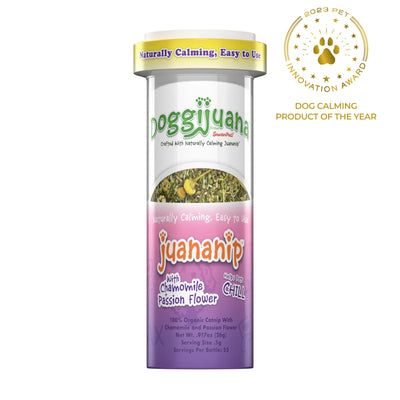
💡 Pair with Juananip® Bites given at mealtime daily for a stronger ongoing calm baseline.
Catnip for Dogs? Really?
This is the most common question, and it makes complete sense. Catnip is famously associated with cats — the rolling, chirping, euphoric response that most cat owners know well. Why would the same plant calm a dog?
The answer is neurological. Cats and dogs respond to catnip through entirely different mechanisms.
In cats, catnip's active compound — nepetalactone — binds to specialised olfactory receptors in the vomeronasal organ and triggers a stimulant, euphoric response. This receptor-driven reaction is unique to felines. Dogs have a vomeronasal organ too, but their receptor architecture is different — nepetalactone doesn't produce the same neurological cascade.
Instead, in dogs, catnip tends to produce the opposite of the feline response: a mild sedative and relaxing effect rather than stimulation. Research suggests that around 60–70% of dogs show a measurable calming response when exposed to catnip — either through ingestion or scent. The response is gentler and shorter-lived than the feline reaction, but it is real and consistent enough across the dog population to make catnip a legitimate calming tool.
Additionally, catnip contains magnesium — a mineral with documented calming effects on the nervous system — as well as vitamins C and E, which support immune function. The nutritional profile makes it a great ingredient to use regularly.
The Chamomile & Passion Flower Blend: Going Deeper
For dogs who need more support than standard catnip provides — highly anxious dogs, dogs with specific triggers, or dogs facing stressful situations — the Chamomile & Passion Flower blend adds two botanical compounds that target anxiety through the GABA pathway.
Chamomile (Matricaria recutita) contains apigenin, a flavonoid that binds to GABA receptors in the brain — the same receptors targeted by pharmaceutical anxiolytics, but far more gently. GABA is the brain's primary inhibitory neurotransmitter: it quiets neural activity and reduces the transmission of anxiety and fear signals. VCA Animal Hospitals recognise chamomile as a veterinary sedative and anti-inflammatory in dogs.
Passionflower (Passiflora incarnata) contains chrysin and related flavonoids that modulate GABA receptor activity through a complementary mechanism to chamomile. The combination of the two herbs covers more of the GABA pathway than either alone — clinical evidence from human research supports a synergistic effect. Passionflower also has mild anxiolytic properties that extend the duration of the calming response.
Together with catnip's sedative base, the Chamomile & Passion Flower blend provides a three-pronged botanical approach to anxiety support — catnip (mild sedative), chamomile (GABA via apigenin), and passionflower (GABA via chrysin).
Juananip Bites: The Serotonin Pathway
Juananip Bites add a fourth mechanism to the calming toolkit: L-tryptophan.
L-tryptophan is an essential amino acid and the direct dietary precursor to serotonin — the neurotransmitter most associated with mood stability and emotional wellbeing. It crosses the blood-brain barrier and is converted first to 5-HTP and then to serotonin, providing a daily baseline of mood support. Unlike the GABA-acting herbs, which are most effective as acute interventions before stressors, L-tryptophan works best when your dog gets it consistently over time — which is why Juananip Bites are designed to be given daily.
Each Bite also contains chamomile extract for additional GABA support, alongside real peanut butter and chicken for palatability. Two to three Bites per day provides both pathways — serotonin through L-tryptophan and GABA through chamomile — in a treat format most dogs find immediately appealing.
How to Use Juananip
In a Toy
Open the pocket of any refillable Doggijuana toy, add a pinch of Juananip, and close it up. The dog engages with the toy through scent and play — sniffing, mouthing, carrying — and the olfactory engagement itself has calming properties. A dog's sense of smell connects directly to the limbic system and the parasympathetic nervous system; nose work is neurologically calming independent of any botanical effect. The Juananip deepens and extends that response.
On Food
Sprinkle a pinch of Juananip over your dog's meal. This is particularly useful for food-motivated dogs who engage less reliably with toys, or for daily use as a calm-support food topper. Ingested catnip produces a calmer, longer-lasting response than scent alone in some dogs.
Before a Stressor
For situational anxiety — fireworks, thunderstorms, car travel, vet visits, grooming — use Juananip with Chamomile & Passion Flower 20–30 minutes before the anticipated stressor. This gives the botanical compounds time to take effect before the anxiety response is triggered.
Daily Supplementation
Juananip Bites, given at 2–3 per day consistently, build serotonin support over time for dogs with ongoing generalized anxiety or a chronically elevated stress baseline. This is a daily habit rather than an acute intervention.
What to Expect: Response Rates and Realistic Outcomes
Approximately 60–70% of dogs show a noticeable calming response to catnip. The remaining 30–40% show minimal reaction — this is genetic and normal, just as some cats don't respond to catnip. If your dog falls into the non-responder group for straight catnip, the Chamomile & Passion Flower blend or the Bites are worth trying, as the GABA and serotonin pathways work independently of the catnip response.
Juananip is not a sedative. Dogs remain alert, functional, and able to interact normally — they simply do so from a calmer physiological baseline. The goal is relaxed engagement and a more settled demeanor, not drowsiness.
For a deeper look at the science behind scent-driven play and why it matters so much for dogs, read our complete guide: Scent-Driven Play for Dogs: The Complete Guide.


