Are Cats Smarter Than Dogs? What the Neuroscience Actually Shows
November 20, 2024·Chris Glissman·7 min read
The short answer is neither — but the research explains why that's the wrong question. Cats and dogs evolved completely different cognitive architectures. Here's what the neuroscience actually found.
The question isn't really whether cats or dogs are smarter. It's whether "smart" even translates the same way across two species that evolved for completely different things. Dogs became collaborative. Cats stayed independent. Both paths produced genuinely impressive cognitive architecture, just aimed in different directions.
What the research actually shows is more interesting than a simple ranking.
The study that reframed the whole debate
Research comparing neuron density in the cerebral cortex — the part of the brain responsible for thinking, planning, and complex problem-solving — found that cats have a notably higher concentration of neurons in key cortical regions than dogs. More neurons per unit doesn't automatically mean "smarter," but it does suggest more processing bandwidth in the areas tied to independent analysis and sensory integration.
Dogs, meanwhile, show broader neural investment in social processing — the cognitive machinery needed to read human cues, follow instructions, and coordinate with a group. Neither arrangement is superior. They reflect what each species needed to survive.
Cats evolved as solitary hunters who had to figure things out alone. Dogs evolved as pack animals who needed to read and respond to others. Both put their neurons where it counted.
What dogs genuinely do better
Dogs follow pointing gestures almost instinctively. You point at something, a dog looks. Most other animals — including chimpanzees and wolves — need extensive training to develop the same behavior. Dogs do it naturally from puppyhood, without being taught.
That's not a party trick. It reflects deep social cognition: the ability to understand that another mind is trying to communicate information. Dogs also read human emotional cues with impressive accuracy, often adjusting their behavior before their owner has said a word.
Trainability follows from this. Dogs are eager to learn structured tasks because they're motivated by social reinforcement. The reward of working with you and earning approval is itself the point. That's why dogs thrive in service work, search and rescue, and jobs that require following human direction under pressure. Cooperation is their native mode.
What cats genuinely do better
Cats outperform dogs on tasks that require working independently without human guidance. Give a cat a puzzle with a food reward and no coaching, and they'll work it longer and more persistently than dogs in comparable tests — especially once they've figured out that help isn't coming.
Cats also show stronger object permanence: the understanding that objects continue to exist even when out of sight. They'll track a hidden toy or target more persistently, which suggests better working memory for spatial location. That's a key skill for a predator that needs to remember where prey disappeared to.
Spatial memory more broadly is a cat strength. A cat allowed to roam a space will develop a detailed internal map — where things are, where they've seen movement, where exits are. That's the mental model of an animal that hunts alone and needs to know its territory with precision.
And while cats get unfairly labeled as emotionally distant, they form genuine attachments. They're just on different timelines and use different signals: slow blinks, head bunts, proximity choices, deliberate eye contact. The bond is real. The expressiveness is calibrated differently.
Cats vs. dogs: who wins each cognitive category?
Select a category to see where each species has the edge — and why.
Edge: Dogs
Dogs learn structured commands faster and retain them more reliably. Their social motivation means human approval is itself a reward — the "good dog" matters as much as the treat. That feedback loop makes them ideal for obedience training, multi-step tasks, and roles that require consistent execution under direction.
Cats can be trained, but the system works differently. They respond to food motivation and tasks that make sense on their own terms. They're not refusing commands out of stubbornness — they're simply less driven by human approval as a motivator. Train a cat with the right incentive and they'll learn. Train them expecting a dog's responsiveness and you'll both be frustrated.
Edge: Cats
When working independently without human guidance, cats show more persistent problem-solving behavior. They'll attempt a challenge longer, try more varied approaches, and appear less frustrated by the lack of feedback. Dogs facing the same solo puzzle tend to disengage faster and look to their owner for help.
This tracks with evolutionary history. Cats hunted alone and had to figure out each problem themselves. Dogs hunted in packs and could offload complexity to the group. Independent problem-solving was a survival requirement for cats; for dogs, it was optional.
Edge: Dogs
Dogs follow pointing gestures instinctively — an ability most animals, including chimpanzees and wolves, need explicit training to develop. You point, a dog looks. That's a sophisticated social inference: understanding that another mind is deliberately directing attention somewhere meaningful.
Dogs also read human facial expressions and body language with impressive accuracy, often adjusting behavior before their owner has spoken. Cats can learn to interpret human cues, but they need more exposure and motivation to develop those skills. It's not that cats can't — it's that social cues were never their primary information channel.
Tied
Both species show strong episodic memory — the ability to remember specific past events. Where they differ is in what they prioritize remembering.
Cats hold a slight edge in spatial memory: they build precise mental maps of their environment and remember the location of prey, exits, and territory boundaries with high accuracy. Dogs hold a slight edge in social memory: they're better at recognizing faces, voices, and relationship history over long stretches of time. Each type of memory served a different evolutionary purpose.
Tied
Both species form genuine emotional bonds with humans. The difference is in how those bonds are expressed — not how deep they run.
Dogs signal emotions overtly: tail wags, whining, seeking physical contact, mirroring their owner's mood. Cats signal them subtly: slow blinks, head bunts, sitting nearby, deliberate eye contact. Research has shown that cats recognize their owner's voice and show signs of attachment when separated — they're just less performative about it. The bond is real. The expressiveness is calibrated for a different social world.
Edge: Cats
Cats adapt to new environments through self-reliance: mapping spaces independently, assessing threats without input, adjusting routines based on their own observations. Move a cat to a new home and they'll systematically explore, catalog, and make it their own — on their schedule, without needing guidance.
Dogs adapt through social integration. They need their human group to establish that a new environment is safe before they fully settle. That's not a weakness — it's a reflection of their pack-based wiring. But it means cats require less external scaffolding when circumstances change. Their default state is independent operation.
These comparisons reflect general research findings across species. Individual cats and dogs vary widely — breed, age, and enrichment history all affect cognitive performance.
What this means if you have a cat
Cat intelligence doesn't show up passively. A cat sitting on the couch isn't giving you a read on their cognitive capacity. You see it in how they engage with their environment when it's actually interesting.
A cat that seems checked out isn't displaying low intelligence. They're displaying a bored intelligence with nothing to aim at. Cats need things to stalk, assess, problem-solve, and chase — not just a spot near the window.
Catnip plays into this. The response isn't just rolling around. It activates a full prey-response sequence: stalk, pounce, bat, reset. A good catnip toy engages the same neural pathways that made cats effective solitary hunters. For an indoor cat, it's one of the few ways to run that loop without actual prey. Our indoor cat enrichment guide covers how to build a full routine around how cats actually think.
Enrichment that matches how cats think
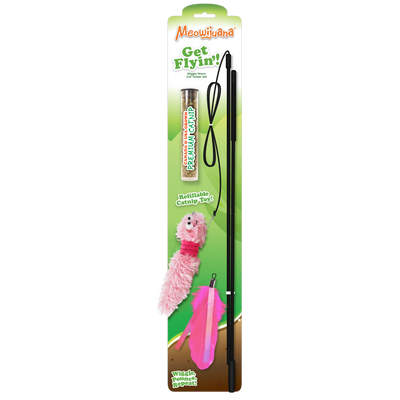
Get Flyin'! Wiggly Worm Cat 36" Teaser Set
$ 13.99
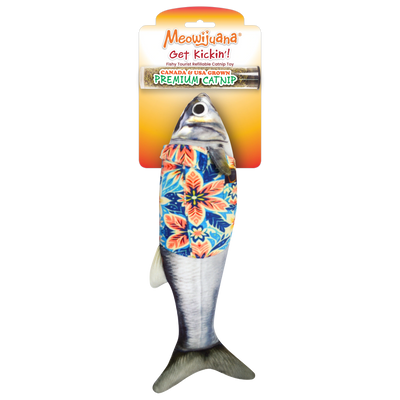
Get Kickin' Big Fishy Tourist Refillable Kicker Cat Toy
$ 10.99
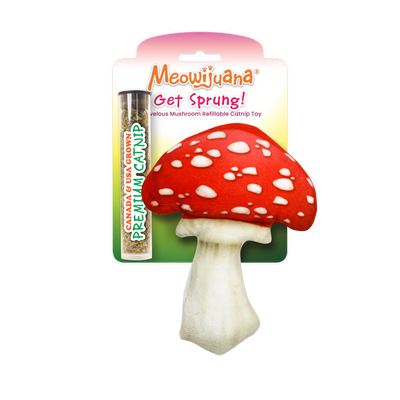
Get Sprung Mushroom Refillable Cat Toy
$ 9.99
So which one is actually smarter?
Neither, in any useful sense. The cat's cortical neuron density and the dog's social cognition are both genuinely impressive. They represent different evolutionary solutions to different problems. Ranking them against each other is like asking whether a chess grandmaster is smarter than a competitive marathon runner — the skills don't translate.
What does carry over is this: understanding how your cat thinks should shape how you set up their environment. Independent problem-solving, spatial exploration, prey-sequence play — these aren't optional add-ons. They're what the cat's brain was built for.
What kind of enrichment does your cat's intelligence need?
3 quick questions — get a play format and product recommendation matched to how your cat thinks.
Question 1 of 3
When your cat plays, they prefer to...
Question 2 of 3
Your cat's energy level is...
Question 3 of 3
Your cat's catnip response...
Your cat's type
Active Hunter
Your cat has a strong prey drive and needs high-movement, high-engagement play. The best sessions for them involve something they can chase, intercept, and "catch" — wand and teaser toys are the format their brain is wired for. A potent hybrid blend like Meowi Waui keeps the response sharp across sessions without desensitizing the way straight catnip can over time.
Best toy format
Get Flying! Wiggly Worm Teaser Set
Fishing-pole design with changeable lures — the movement pattern matches what an active hunter tracks in prey. Refillable catnip pocket extends each session.
Best blend
Meowi Waui
Hybrid formula balances stimulation and duration — your cat gets the full response without burning out in 30 seconds.
Your cat investigates before committing and prefers play they can control. They're not disinterested — they're assessing. Kicker toys suit this type well: they can grab, bunny-kick, and work on their own without needing you to drive the action. A calming blend like Mice Dreams extends engagement and keeps them in the "thinking" window longer rather than escalating to the zoomies phase.
Best toy format
Get Kickin' Big Fishy Tourist
Full-body kicker with a refillable catnip pouch — lets your cat grab, kick, and work the toy independently at their own pace.
Best blend
Mice Dreams
Relaxing blend keeps engagement calm and sustained — better for thoughtful players who explore rather than sprint.
Your cat is selective about when and how they engage. They're not low-intelligence — they're high-standard. Door-frame toys like the Jump n Jamb give them control over the interaction: they can bat, retreat, and re-engage on their own terms without needing you to wave something at them. If they're not responding to regular catnip, silvervine is worth trying — it activates a different receptor and works on about a third of cats who don't respond to catnip at all.
Best toy format
Jump n Jamb Monkey
Door-frame mounted with an elastic cord — always available, self-directed, no performance required from your cat (or you).
Try this for non-responders
Catnip + Silvervine Spray
Silvervine activates a different neurological pathway than catnip. Many cats who don't respond to catnip respond strongly to silvervine — worth testing before writing off enrichment entirely.
Your cat has a mixed profile — some traits from multiple play styles. The best approach is rotation: vary the toy format and catnip formula across sessions so they're always encountering something slightly new. A plush toy with a refillable pocket works well as a base because it covers both the tactile and scent enrichment channels. Purrple Passion is a stimulating blend that tends to produce a stronger response than standard catnip for cats who hover in the middle.
Best toy format
Get Sprung Refillable Mushroom
Plush with a refillable catnip pocket — soft enough to bunny-kick, scented enough to engage the prey-response circuit. Works across most play styles.
Best blend
Purrple Passion
Stimulating formula with a stronger response profile — good for cats who respond to catnip but only mildly. Often unlocks more engagement than standard blends.
Neither is objectively smarter. Cats outperform dogs on independent problem-solving and spatial memory. Dogs outperform cats on social cognition and trainability. Which looks smarter depends entirely on the task you're measuring.
What does neuron research say about cat vs dog intelligence?+
Research comparing cerebral cortex density found cats have a higher concentration of neurons in key cortical regions than dogs. Dogs show broader neural investment in social processing. Neither arrangement is superior — they reflect what each species evolved to do.
Can cats be trained like dogs?+
Yes, but the motivation system works differently. Dogs respond strongly to social approval and teamwork. Cats respond to food rewards and personal interest. Cats can learn a wide range of behaviors — training just needs to work with their autonomy rather than against it.
Why does my cat seem to ignore me sometimes?+
Research shows cats recognize their owner's voice and know their name, but choose whether to engage based on their own assessment of the situation. That's not a cognitive failure — it's decision-making. Cats are less socially motivated than dogs, so they don't respond to human cues on instinct the way dogs do.
What kind of enrichment works best for a smart cat?+
Cats need variety across sensory channels: things to stalk (wand or teaser toys), things to investigate through scent (catnip, silvervine), things to problem-solve (puzzle feeders), and spaces to map (vertical territory, window access). Rotating between formats keeps novelty up and prevents boredom.
How does catnip connect to cat intelligence?+
Catnip activates the prey-response circuit — the neural pathways cats use for hunting, stalking, and play. The response sequence (stalk, roll, bat, reset) mirrors natural hunt behavior. For indoor cats, it's one of the few ways to engage the full cognitive and physical hunting loop that their brains were built for.
🐱
The SmarterPaw Team
We're the team behind Meowijuana — found in 7,000+ retailers worldwide including PetSmart, Petco, and Walmart. Founded in 2015 in Lenexa, Kansas.