


Chamomile gets a lot of questions in the cat world, and most of them have the same answer: yes, it's safe, when it's the right form, in the right amount. The confusion lives in the form.
This is the breakdown of which forms work, how much is too much, what to skip entirely, and how chamomile shows up in our calming catnip blends.
Why chamomile is safe for cats (when it's the right form)
Chamomile is one of the most cat-friendly calming herbs in herbal medicine. Dried chamomile in a calming catnip blend is safe. Plain brewed chamomile tea, cooled to room temperature, is mostly safe. Chamomile essential oil is not, but that's about essential oils generally, not chamomile specifically.
The two species you'll encounter are Roman chamomile (Chamaemelum nobile) and German chamomile (Matricaria chamomilla). Both are safe for cats in dried form at the amounts used in formulated blends. Most cat products use German because the calming compound profile is slightly more reliable.
What changes the safety calculation isn't the species. It's the concentration and the form. Dried chamomile flowers contain modest amounts of apigenin (the calming compound) and don't pose meaningful risk at low percentages. Essential oils and tinctures concentrate the same compounds at levels cats' livers process slowly. Same chemistry, very different doses.
The fresh whole plant in your garden is a third category. Most cats won't bother with it because the bitterness puts them off, but a cat that consumes a significant amount of fresh chamomile flowers can have mild GI upset (chamomile is part of the daisy family and shares some compounds with ragweed). Trace amounts on a paw or a quick sniff are nothing to worry about.
So "chamomile and cats" is really three different conversations: dried form, brewed tea, and essential oil. Two of those are safe; one isn't. We'll get to each.
What chamomile actually does for cats
Chamomile's calming effect on cats works through a compound called apigenin, which binds to the same GABA receptors involved in human anxiety relief. Cats and humans share this neural pathway, which is why chamomile shows up in calming products across both species.
What it actually does in a cat is mild settling. Lower heart rate. A general "this is fine" baseline state. It's not euphoric like catnip; there's no rolling around or zoomies. The effect is closer to the relaxation you'd associate with a familiar warm blanket than to anything dramatic.
A few other things chamomile contributes:
- Mild digestive support. The bitter compounds in chamomile have a long history of use for gentle digestive upset.
- Anti-inflammatory properties at higher doses (more relevant in chamomile tea than in a trace pinch in a blend).
- Sleep support. The same compounds that help humans wind down before bed work mildly on cats, useful for cats prone to nighttime restlessness.
What chamomile doesn't do: cure anxiety disorders, treat infections, replace prescription calming medications, or dramatically transform an anxious cat's baseline state. It's a supporting ingredient. The dramatic effect cats have to catnip isn't chamomile's job. Its job is the quieter, longer-lasting calm, and as a supporting herb in a calming blend, it does that well.
Can cats have chamomile tea?
Chamomile tea is one of the most common questions in this cluster, and the answer is yes, with caveats.
Plain brewed chamomile tea, cooled to room temperature, is safe for cats in small amounts. A teaspoon or two offered in a separate dish is fine if your cat happens to like it. Most won't.
The caveats matter:
- Plain chamomile only. Tea blends often contain other ingredients like black or green tea (caffeine), peppermint, lemon balm, or citrus zest. Caffeine is toxic to cats in even small amounts. Always check the ingredients on a tea bag before offering.
- Cooled to room temperature. Don't give your cat hot tea. The heat itself is a burn risk, and the volatile oils that come off hot tea can irritate.
- No additives. No honey, no sugar, no milk, no cream, no lemon. Just brewed chamomile flower water.
- Small amount. A teaspoon or two, not a saucer full. Watch how your cat responds before offering more.
The bigger truth is that most cats won't drink chamomile tea. The taste is bitter and unfamiliar, and cats are generally suspicious of new liquids. If you want the calming effect of chamomile without the production of brewing tea your cat may ignore, dried chamomile in a calming catnip blend gives you the same compound with much higher cat-acceptance and no risk of accidental additives.
Do cats actually like chamomile?
Most cats are neutral on chamomile. It's not catnip; there's no triggering compound that drives an enthusiastic response. Some cats sniff and walk away, some are mildly interested, very few are actively drawn to it.
What we've observed (and what the limited research suggests) is that some cats do settle down around small amounts of chamomile in the environment. The olfactory pathway that helps humans wind down with chamomile tea works in cats too, at least mildly. That effect is much subtler than the catnip response your cat may already love.
The reason chamomile shows up in calming catnip blends isn't because cats love the taste or smell of chamomile specifically. It's because chamomile pairs well with catnip's stimulating compounds. Your cat gets the catnip response first, then chamomile's gentler compounds support the come-down. The combined effect is more rounded than catnip alone.
If your cat ignores chamomile-containing blends in favor of pure catnip, that's not a sign chamomile isn't "working." It's a sign that catnip is doing most of the heavy lifting. The chamomile is still contributing its calming work in the background. If you want to compare chamomile to other calming herbs cats respond to, our valerian root vs catnip post covers what valerian does differently.
How we use chamomile in calming catnip blends
Chamomile shows up across the calming side of our lineup. Four blends use it most visibly:
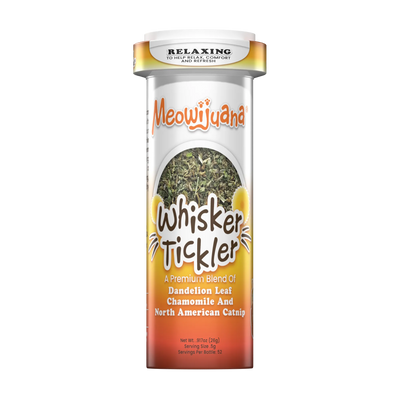
- Whisker Tickler is a calming-leaning blend that pairs catnip with chamomile and dandelion leaf.
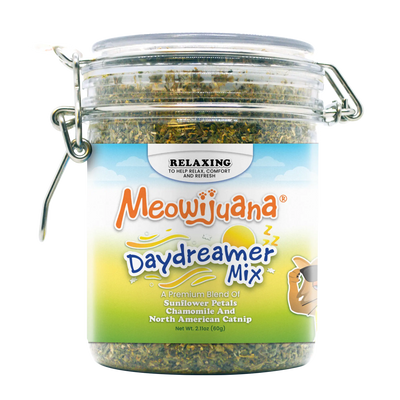
- DayDreamer is a floral blend with catnip, chamomile, and sunflower petals. Lighter floral character.
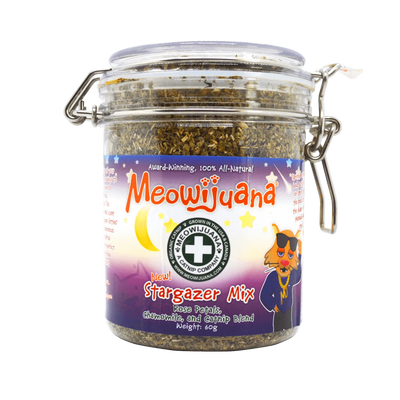
- Stargazer is a floral blend with catnip, chamomile, and rose petals. Stronger floral note.
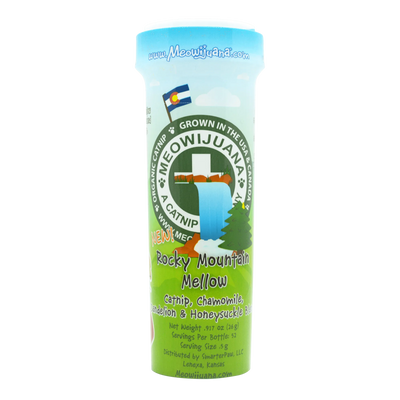
- Rocky Mountain Mellow is a multi-herb blend with catnip, chamomile, dandelion leaf, and honeysuckle.
In each case, the chamomile is dried German chamomile, never essential oil or hydrosol. The role is supportive: the catnip drives the active engagement, the chamomile contributes the longer-lasting calm. We keep chamomile well below the 2% formulation ceiling that's considered safe for cats across the industry.
If you have both a cat and a dog at home, the dog side has its own chamomile product, Juananip with Chamomile & Passion Flower, which uses the same supportive principle for dogs that respond to catnip's calming compound. We cover the full dog-specific picture in our chamomile for dogs guide if you want both halves of the household covered.
If you want the broader chemistry on how catnip works (and why blending it with herbs like chamomile amplifies certain effects), our catnip guide covers the mechanism.
Calming catnip blends with chamomile
You can also browse the full lineup of calming, stimulating, and hybrid blends to see which fits your cat's profile.
How much chamomile is safe?
For dried chamomile in a calming catnip blend, the practical safety ceiling sits around 2% by weight. Our blends stay well below that. That works out to less than a pinch of actual chamomile per 1/8-cup serving.
For loose dried chamomile (sprinkled on a toy or kicker), a small pinch (about 1/8 teaspoon) at a time is plenty. A pinch a few times per week is the upper bound. Daily exposure isn't necessary and can dull the calming effect over time.
For chamomile tea, a teaspoon or two of plain cooled tea is the safe amount. Not a saucer, not refilled when finished. Small offered amount, watch your cat's response.
What "too much" looks like for chamomile is gentler than for most herbs. Chamomile is a mild herb at the amounts cats can realistically consume. The warning thresholds are: more than a tablespoon of dried chamomile consumed at once, more than a few ounces of tea, or any essential oil. For most household exposure (a few leaves nibbled from a chamomile plant, a serving of a blend, a sip of cooled tea), there's no realistic concern.
What to avoid: essential oil, tinctures, human supplements
Three forms of chamomile to keep away from your cat:
Essential oil. Concentrated chamomile essential oil contains apigenin and other terpenes at levels cats' livers process slowly. Diffused for hours in a closed room, or applied topically to a cat's skin, essential oil exposure can cause GI upset, weakness, or in concentrated cases liver stress. Diffusers are the single most common risk. Your cat is breathing concentrated terpenes continuously.
Tinctures and concentrated extracts. Most chamomile tinctures use alcohol as the carrier, which is toxic to cats even in small amounts. Glycerin-based extracts exist but are difficult to dose accurately for cat body weight. The dried form covers the same use cases with much easier dose control.
Human chamomile supplements. Capsules, tablets, and human-formulated calming products contain doses calibrated for human body weight and metabolism. The fillers (magnesium stearate, vegetable cellulose, sometimes xylitol) aren't appropriate for cats either.
The pattern here is the same one that comes up with most herbs. The dried form is forgiving. Concentrated forms aren't. Our lavender for cats guide covers the dried-versus-oil principle in more detail.
Signs of a reaction (rare)
For trace exposure (a few flowers from a chamomile plant, a serving of a blend, a sip of cooled tea), there's nothing to watch for. Chamomile reactions are rare at normal household amounts.
For larger amounts (your cat ate a substantial pile of dried chamomile or fresh flowers, or you suspect essential oil exposure), watch for:
- GI upset: drooling, vomiting, or loose stool within a few hours
- Lethargy: unusual sleepiness, less responsive
- Allergic reaction: itching, swelling, or hives (chamomile is in the daisy family, and cats with ragweed sensitivity occasionally cross-react)
For dried-chamomile exposure, even substantial consumption rarely causes more than mild GI upset that resolves on its own. For essential oil exposure, treat as more urgent and call your vet immediately, even if your cat seems fine.
For chemical exposure suspicion, contact the ASPCA Animal Poison Control at (888) 426-4435 or the Pet Poison Helpline at (855) 764-7661.


