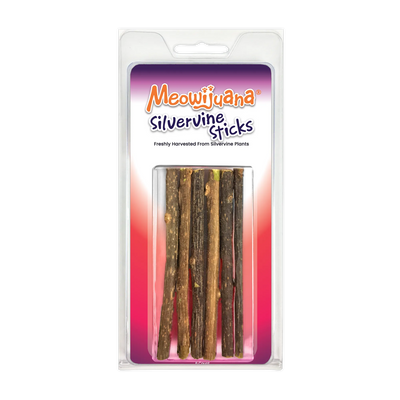
Silvervine sticks engage cats through chewing — not just scent — and roughly 80% of cats respond to them, including most catnip non-responders. Here's how they work, what's actually true about the dental claims, how to use them safely, and which cats they're right for.
Why silvervine sticks work where other formats don't
Silvervine sticks are an underrated product in the cat enrichment world. They look simple — a small piece of dried wood, no fabric, no fill, no electronics — but they do something most cat toys can't: they engage a cat through chewing rather than just scent. That distinction matters more than it sounds, and it's the reason silvervine sticks have such a loyal following among cat owners whose cats have outgrown every other toy in the house.
This guide covers what silvervine sticks are, how they work, the dental story (and what's actually true about it), how to introduce them safely, and which Meowijuana cats they're right for.
Will your cat respond to silvervine?
Three questions — we'll give you a likelihood estimate based on what we know about silvervine response rates.
Question 1 of 3
How does your cat respond to catnip?
Question 2 of 3
How old is your cat?
Question 3 of 3
Has your cat ever tried silvervine before?
Predicted response
—
Why cats respond to silvervine
The short version: silvervine contains six active compounds that engage cats' olfactory systems and produce a euphoric response — similar in feel to catnip, but stronger and longer-lasting for many cats. About 80% of cats respond to silvervine, compared to about 70% who respond to catnip. More importantly, roughly 75% of cats who don't respond to catnip do respond to silvervine — which makes it the most reliable backup compound for the genetic catnip non-responder population.
If you want the deeper science of how silvervine compares to catnip, our silvervine vs catnip guide covers the chemistry and response patterns in detail. The rest of this post is about sticks specifically — the format, not the compound.
What makes the stick format different
Most silvervine products deliver the compound through smell — powder you sprinkle on a toy, oil in a spray, dried leaf packed into a Velcro pocket. Sticks are different because they engage the cat through chewing.
When a cat chews a silvervine stick, their saliva makes direct contact with the inner wood fibers, releasing the active compounds in higher concentration than scent alone. The cat keeps chewing because the response keeps coming. A session with a stick is typically longer and more sustained than a session with a powder or spray, because the engagement loop is reinforced with every bite.
The other thing sticks do that other formats can't: they let your cat work on the toy. Many indoor cats don't get enough oral stimulation, and a stick scratches that itch in a way scent enrichment alone doesn't.
The dental angle — what's actually true
This is the area where you'll see the most marketing hype, so let's separate the real from the exaggerated.
What's true: chewing on a silvervine stick produces mild mechanical scraping of the tooth surface, increases saliva flow (saliva is your cat's natural defense against oral bacteria), and gives your cat the kind of voluntary repeated chewing that dental products generally fail to achieve.
What's not true: silvervine sticks are not a replacement for professional dental cleanings. They aren't a treatment for existing dental disease. They aren't proven by clinical trials at the level of, say, a Greenies treat or a vet-prescribed dental food.
The honest framing: silvervine sticks are an enrichment toy with mild dental side benefits. Most "dental treats" fail because cats won't engage with them. Silvervine sticks succeed at engagement, and the dental benefit comes along for the ride. If your cat has visible tartar buildup or signs of gum disease, talk to your vet about a cleaning — sticks supplement that, they don't replace it.
How silvervine sticks support dental health
Click each step to see what's happening — from the moment your cat starts chewing.
1
Chewing engages the compound
Saliva activates the active ingredients
Silvervine's active compounds — actinidine and dihydroactinidiolide — are most strongly released when the wood is chewed and the saliva makes contact with the inner fibers. Sticks deliver more sustained engagement than powder or sprays for this reason: the cat keeps chewing because the response keeps coming.
2
Repeated chewing scrapes plaque
Mechanical action on tooth surfaces
The wood fibers are slightly abrasive — chewing the stick produces a similar mechanical effect to a dental treat. It's not a substitute for a vet cleaning, but regular chewing on a silvervine stick provides some passive plaque control between cleanings, particularly along the tooth-and-gum line where cats most often develop tartar.
3
Increased saliva flow
Saliva is your cat's natural mouth cleaner
Chewing triggers saliva production, and saliva is the cat's natural defense against oral bacteria. More saliva means more rinsing of the gum line and better natural pH balance in the mouth. This is one reason chew toys generally support dental health even when they're not specifically dental products.
4
Engagement they actually return to
Voluntary repeat use is the key
Most "dental treats" fail because cats won't engage with them long enough to matter. Silvervine sticks solve that — the cat actively wants to chew. Repeated voluntary use across days and weeks is what produces the cumulative dental benefit, not a single chewing session.
Honest caveat
Silvervine sticks aren't a clinically validated dental treatment. They're a chewing toy with mild dental side benefits. If your cat has significant tartar buildup or signs of dental disease, talk to your vet about a professional cleaning — sticks supplement that, they don't replace it.
Are silvervine sticks safe?
For healthy adult cats, yes — silvervine sticks are non-toxic, non-addictive, and don't produce dependency. The same body of safety research that supports catnip use supports silvervine too. There are no known long-term health risks.
A few practical use guidelines do apply, though, and most issues come from skipping these:
Supervise the first few sessions to confirm your cat's chewing style is normal — not obsessive
Limit sessions to roughly 15 minutes for the rare cat who would otherwise chew indefinitely
Replace the stick when it starts looking frayed or splintering
Skip silvervine for kittens under six months — their teeth aren't built for hard chewing yet, and they often don't respond to scent stimulants at that age anyway
In multi-cat households, give each cat their own stick during a session — strong responders can become resource-guarded over a single stick
Silvervine stick safety — the working list
Silvervine sticks are safe for healthy adult cats. A few use guidelines keep them safe.
✓
Supervise the first few sessions
Most cats settle into a normal chewing rhythm fast. Watch the first 2–3 sessions to confirm yours is one of them.
✓
Limit sessions to about 15 minutes
Cats self-regulate, but if your cat is the rare obsessive chewer, set a session window and put the stick away when the time is up.
✓
Replace when frayed or splintering
A heavily worn stick can produce small splinters. When the surface starts looking shredded or any pieces feel loose, replace it.
✓
Store dry between uses
Silvervine wood holds potency better when dry. A drawer or sealed container keeps the scent intact.
✓
Start with one stick per cat
In multi-cat households, give each cat their own stick during a session. Sticks can become resource-guarded for strong responders.
✗
Don't give to kittens under 6 months
Kittens under six months often don't respond to scent stimulants yet — and their developing teeth aren't built for hard chewing. Wait until they're older.
✗
Don't leave a splintered stick out
Once a stick is heavily frayed, retire it. A clean replacement is cheaper than a vet visit for a swallowed splinter.
✗
Don't use as a tooth-cleaning substitute
Sticks support dental health — they don't replace a vet cleaning. If your cat has visible tartar or gum disease, talk to your vet first.
✗
Don't soak or wet the sticks
Wet wood is harder to chew safely and can mold. Keep them dry.
✗
Don't pair with intense play immediately after
Some cats can become disoriented if they're chewing silvervine and then asked to do high-energy interactive play. Let the response settle for 10–15 minutes between activities.
Bottom line: healthy adult cats use silvervine sticks safely with normal supervision. Replace when frayed, store dry, and give kittens under six months a different enrichment toy in the meantime.
How to introduce a silvervine stick
The mistake most cat owners make on day one is leaving the stick on the floor and waiting. Some cats engage immediately. Many don't — and if the stick gets ignored on day one, it tends to stay ignored.
Better approach: hand the stick to your cat during a play session that's already underway. Get them moving first with a teaser or wand toy, then offer the stick when the energy is up. The arousal transfers to the new object, and the stick imprints as a play tool rather than a curiosity.
Once your cat engages, no further intervention is needed. They'll come back to the stick on their own. Most active cats use a stick across many short sessions per week for several weeks before the wood loses enough scent to retire.
Sticks slot into the compressed-catnip category in a full kit — non-fabric, single-use, complementary to the refillable toys. Our best catnip toys guide covers where everything fits.
Our pick
Best silvervine stick
Silvervine Sticks
$ 9.99
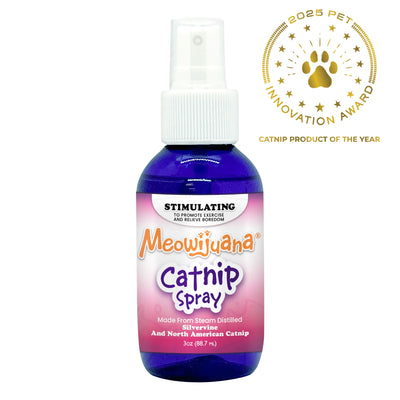
Catnip & Silvervine Spray - 3 oz.
$ 10.99
Meowijuana Silvervine Sticks are the cleanest entry to this category — pure silvervine wood, sized for adult cats, supervised use as described above. If you want to test silvervine with a less committed format first, the Catnip & Silvervine Spray is our combination spray (the only product of its kind, because we're the only manufacturer producing silvervine oil) — mist it on a toy your cat already owns and see what happens before moving up to a stick. For a deeper guide to all our spray formats, see our complete catnip spray guide.
When to retire a stick
A silvervine stick has a natural working life of several weeks to a few months, depending on how often your cat uses it and how hard they chew. Three signs it's time to replace:
The surface is heavily frayed or splintering
Your cat sniffs it and walks away (the scent is gone)
You can feel the wood softening when you pick it up
A retired stick isn't a candidate for soaking, washing, or refreshing — silvervine isn't a refillable format. When the wood is done, it's done. Replacement sticks are inexpensive and your cat will engage with a fresh one within minutes.
The bottom line
Silvervine sticks aren't for every cat, but they earn their spot in the kit for two distinct groups. First, catnip non-responders — roughly one in three cats — find their scent compound in silvervine, and sticks are the most engaging format to test it with. Second, strong catnip responders often find silvervine produces an even bigger reaction, particularly when they can chew rather than just smell.
Either way, the stick format is what makes silvervine work at its best. The active compounds release through chewing, the sessions sustain longer, and the dental side benefit shows up for free. For a few dollars and a moment of supervision, it's hard to find a better enrichment-to-cost ratio in the entire cat-toy market.
Frequently asked questions
Are silvervine sticks safe for cats?+
Yes, silvervine sticks are safe for healthy adult cats. Silvervine is non-toxic, non-addictive, and doesn't produce dependency. The same body of safety research that supports catnip use supports silvervine too. The main safety guidelines: supervise the first few sessions, replace the stick when it starts looking frayed or splintering, give each cat their own stick in multi-cat households, and skip silvervine sticks for kittens under six months (their teeth aren't built for hard chewing yet).
Do silvervine sticks clean cats' teeth?+
Silvervine sticks provide mild dental side benefits — chewing scrapes the tooth surface, increases saliva flow (a natural defense against oral bacteria), and produces the kind of voluntary repeated chewing that dental products generally fail to achieve. They are not, however, a replacement for professional dental cleanings or a treatment for existing dental disease. The honest framing: silvervine sticks are an enrichment toy with mild dental side benefits, not a clinically validated dental treatment. If your cat has visible tartar or signs of gum disease, talk to your vet.
What are silvervine sticks for cats?+
Silvervine sticks are dried wood from the silvervine plant (Actinidia polygama), shaped into small chewable sticks for cats. Silvervine contains six active compounds — including actinidine and dihydroactinidiolide — that engage cats' olfactory systems and produce a euphoric response similar to catnip. The stick format is unique because it engages cats through chewing, which activates the compounds via saliva contact in higher concentration than scent alone. About 80% of cats respond to silvervine, including roughly 75% of cats who don't respond to catnip.
What's the difference between silvervine sticks and catnip?+
Three main differences. First, response rate: about 80% of cats respond to silvervine versus about 70% to catnip, and roughly 75% of catnip non-responders do react to silvervine. Second, intensity: silvervine often produces a stronger and longer-lasting reaction than catnip. Third, format: silvervine sticks are chewable wood that engages through chewing, while most catnip products are dried leaf, sprays, or pressed catnip you smell or rub. For deeper detail see our silvervine vs catnip guide.
Are silvervine sticks safe for kittens?+
Wait until your kitten is at least six months old. Two reasons: first, kittens under six months often don't respond to scent stimulants like silvervine or catnip because the relevant brain receptors are still developing. Second, kitten teeth aren't built for the kind of hard chewing a silvervine stick invites. For young kittens, use a soft refillable plush toy lightly misted with catnip spray instead — much gentler on developing teeth and claws.
How long does a silvervine stick last?+
A silvervine stick has a working life of several weeks to a few months, depending on how often your cat uses it and how hard they chew. Three signs it's time to replace: the surface is heavily frayed or splintering, your cat sniffs it and walks away (the scent is gone), or the wood feels softer when you pick it up. Silvervine isn't a refillable format — when the wood is done, it's done. Replacement sticks are inexpensive.
Can silvervine sticks be used with multiple cats?+
Yes, but give each cat their own stick during a session. Strong responders can become resource-guarded over a single stick, which creates friction in multi-cat households. Buying multiple sticks at once is the simplest solution, and silvervine sticks are inexpensive enough that this is rarely a real cost concern. Supervise the first multi-cat session to confirm everyone is engaged with their own stick rather than competing for one.
What if my cat ignores a silvervine stick?+
Two possibilities. First, your cat may be in the small minority of cats who don't respond to silvervine — about 20% don't engage with it even after a fair test. Second, the stick may not have been presented well: cats are more likely to engage with a new toy when it's introduced mid-play session, not left on the floor cold. Try presenting the stick during an active wand-toy session. If your cat still ignores it after several attempts, valerian root is the next compound to test as a silvervine alternative.
How do silvervine sticks compare to silvervine powder or spray?+
Powder and spray deliver silvervine through scent. Sticks deliver it through chewing — saliva contact releases the active compounds in higher concentration than smell alone, which produces a longer, more sustained engagement. Sticks also give cats voluntary oral stimulation that powder and spray can't, and they have mild dental side benefits from the mechanical chewing. For testing whether your cat responds to silvervine in the first place, a combo spray (catnip and silvervine in one bottle) is the lowest-commitment starter. Once you've confirmed engagement, a stick is the higher-quality long-term format.
🐱
The SmarterPaw Team
We're the team behind Meowijuana — found in 7,000+ retailers worldwide including PetSmart, Petco, and Walmart. Founded in 2015 in Lenexa, Kansas.