Are Dandelions Safe for Cats? Yes — Here's What to Know
January 11, 2022·Chris Glissman·7 min read
Dandelions are safe for cats — the whole plant, leaf to root. They're not on any toxicity list, and they're one of the most common supporting ingredients in our calming catnip blends. Here's how much is fine, which parts do what, and what to know about dandelions in your yard.
Dandelions are one of those plants people assume must be dangerous because they grow as weeds. They aren't. The whole plant — leaf, root, and flower — is safe for cats, used regularly in herbal cat blends, and not on a single major toxicity list.
The nuance lives elsewhere: what your cat eats from the yard versus what's in a formulated blend, and what's been sprayed on those yard dandelions in the last few weeks. We'll cover both.
Why dandelions are safe — every part of the plant
Dandelions (Taraxacum officinale) are not toxic to cats. They aren't on the ASPCA's toxic plants list. They aren't on the Pet Poison Helpline's danger list. They aren't on any veterinary nutrition reference as a problem herb. Cats can nibble fresh dandelion leaves, sniff or eat the flowers, and consume small amounts of dried root with no issues.
The reason this surprises some cat owners: dandelions grow as weeds, and weeds tend to be guilty by association. But there's no chemical relationship between "things that grow uninvited in your lawn" and "things that are bad for your cat." Dandelions specifically are a nutrient-dense edible plant — humans eat them in salads (dandelion greens) and as tea (roasted root) — and cats handle them at least as well as we do.
What you should not assume: that every yellow flower in your yard is a dandelion, and that every dandelion in your yard is unsprayed. We'll get into the lawn-chemical question in a few sections. For the plant itself, in clean form, the answer is simple: safe.
Dandelion leaf vs. root vs. flower — what does what
The three parts of the plant have distinct profiles.
Leaves are the most nutrient-dense part. High in vitamins A, C, and K, plus calcium, iron, and potassium. Mild diuretic effect (which is why they show up in some traditional kidney-support blends for humans and pets). The taste is bitter — most cats don't go out of their way to eat raw leaves, but they'll accept them in small amounts as part of a blend.
Root is what shows up most often in herbal supplements — both for humans and for cat blends. Roasted and dried, the root is traditionally used for digestive and liver support. The taste is earthier and bitter. In our blends, when dandelion shows up, it's usually leaf rather than root.
Flowers are edible but mostly just decorative in cat products. Mild flavor, no specific therapeutic claim. Some cats find them mildly interesting as a sensory addition.
All three parts are safe in normal household and blend amounts. The body's response is the same regardless of part: a mild nutritional contribution, minor diuretic effect, and that's about it.
Dandelion leaf vs. root vs. flowers
Three parts of the same plant — all safe for cats, each with a different role.
Dandelion leafMost nutrient-dense part
High in vitamins A, C, K, plus calcium, iron, and potassium. Mild diuretic effect. Bitter taste. This is the form that shows up most often in our calming catnip blends as a supporting ingredient — typically under 1.5% by weight.
Vitamin-richMild diureticBitter taste
Safe for cats
Dandelion rootTraditional digestive support
Used in herbal medicine for digestive and liver support — for humans and pets. Roasted and dried, the root has earthier, more bitter flavor than the leaf. Less commonly used in cat blends than the leaf, but safe when it appears.
Digestive supportLiver supportEarthy / bitter
Safe for cats
Dandelion flowersEdible but mostly decorative
The bright yellow flowers are edible and non-toxic for cats. Mild flavor. Some cats find them sensorially interesting. No specific therapeutic role — they appear in some herbal blends for visual appeal and trace nutrient contribution.
EdibleMild flavorNo specific health claim
Safe for cats
All three parts are non-toxic. The risk you should care about isn't the plant — it's whether the dandelion came from a chemically-treated yard. We cover that in the yard safety section below.
The benefits — what dandelion actually does for cats
Honest framing: dandelion is a supporting ingredient, not a star. It doesn't drive a calming response the way catnip does, and it doesn't deliver dramatic health effects on its own.
What it does contribute:
Mild digestive support. The bitter compounds in dandelion can help with sluggish digestion when used regularly.
Trace nutrient density. Even small amounts add small amounts of vitamins and minerals your cat probably already gets from food, but doesn't hurt to reinforce.
A mild diuretic effect. Helpful in a "broader wellness" sense, not as a treatment for a specific condition.
Blend rounding. In a multi-herb catnip blend, dandelion balances the flavor and adds botanical complexity that some cats clearly enjoy.
What dandelion does not do: cure UTIs, treat kidney disease, fix arthritis, or any of the other claims you'll find on poorly-sourced pet wellness sites. If your cat has a medical issue, dandelion is not the answer — a vet is.
How much dandelion is safe?
In a calming catnip blend, dandelion content under about 1.5% by weight is the practical ceiling. Our blends with dandelion sit between 0.8% and 1.2% — small contributions to a multi-herb mix. That works out to less than a pinch per serving.
For fresh dandelion leaves from a clean yard, a few leaves at a time is fine. A few times a week is more than enough. You don't need to feed it as a supplement, and there's no clinical reason to push the amount higher.
The reason "in moderation" matters even for safe herbs: the mild diuretic effect can become a not-so-mild diuretic effect if your cat consumes large quantities. And anything that's not part of your cat's normal diet — eaten in unusual amounts — can cause GI upset. Small is genuinely better.
How much dandelion is safe for your cat?
Pick the form you're working with. We'll show you the safe amount and what to watch for.
I'm using…
A calming catnip blend with dandelion
Safe amount
A 1/8-cup serving, a few times a week
Why it's fine
Dandelion sits at 0.8–1.2% in our blends — less than a pinch per serving. The catnip does the calming work; dandelion is supporting nutrition.
Watch for
Nothing specific. If your cat has any reaction to a new blend, it's usually the catnip itself or a sensitivity to one of the other herbs, not the dandelion.
Loose dried dandelion (leaf or root)
Safe amount
A pinch sprinkled on food, a few times a week — not daily
Why moderation
Dandelion has a mild diuretic effect at higher doses, and most cats don't need it as a daily supplement.
Warning threshold
Tablespoon-level quantities at once. Watch for increased urination or mild GI upset; call your vet if symptoms persist.
Fresh leaves from your yard
Safe amount
A few leaves at a time, IF your yard is chemical-free
Most important rule
Don't let your cat eat dandelions from any yard that's been treated with weed killer, fertilizer, or pesticide in the last few weeks. The chemical is the danger, not the plant.
Also avoid
Dandelions within 10 feet of a road (traffic pollution residue) and dandelions in neighbors' yards (you don't know what they sprayed).
Dandelion tea
Safe amount
A teaspoon or two of plain, cooled tea, occasionally
Plain tea only
No sweeteners, no milk, no honey, no added ingredients. Just brewed dandelion root or leaves in water, cooled to room temperature.
Reality check
Most cats won't drink it. There's no specific reason to offer tea over the dried form — but it's safe if your cat happens to like it.
A dandelion supplement made for cats
Safe amount
Follow the label dose — these are concentrated
Why label dose matters
Pet supplements typically use extract concentrations much higher than dried herb. Exceeding the label is closer to a high-dose territory than feeding loose leaves.
Talk to your vet
If your cat is on long-term medication or has kidney issues, run any dandelion supplement past your vet first — the diuretic effect could affect meds processed through the kidneys.
How we use dandelion in calming catnip blends
Dandelion leaf shows up across our calming-side lineup as a supporting ingredient. Three blends use it most visibly:
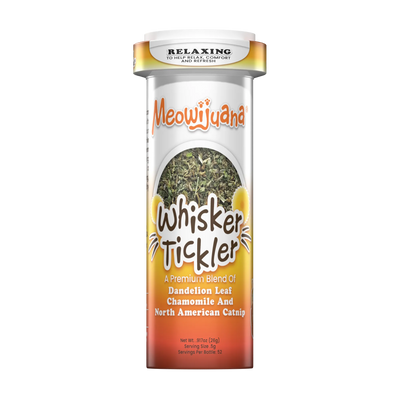
Whisker Tickler — catnip with chamomile and dandelion leaf (1.2%). A calming-leaning blend that pairs the catnip response with gentle herbal accents.
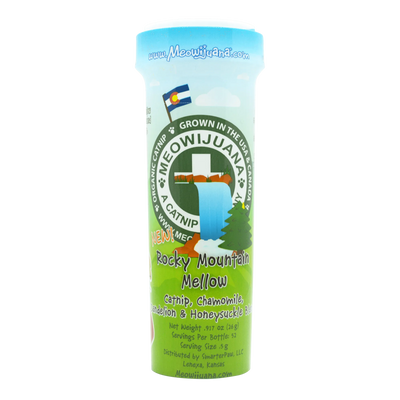
Rocky Mountain Mellow — catnip with chamomile, dandelion leaf, and honeysuckle. Multi-herb, leaning relaxed.
Original Pawty Mix — our flagship multi-herb blend; dandelion sits at 0.9% alongside silvervine, valerian, chamomile, passion flower, and lavender.
In each case the dandelion is dried, never extracted or in essential-oil form. The role is supportive: the catnip and chamomile do most of the calming work, and dandelion adds the nutritional and digestive layer underneath. If you want to learn more about how catnip itself works, our catnip guide covers the mechanism.
Here's where the "are dandelions safe?" question gets more interesting. The plant is safe. The yard isn't always.
Untreated yard. If you don't spray weed killers, fertilizer chemicals, or pesticides, your yard dandelions are fine. Cats nibble grass and flowers all the time; the dandelions in your unsprayed lawn are no different from store-bought herbs in this respect.
Lawn-treated yard. Weed killers (especially 2,4-D and glyphosate-based products) leave residue on plants for days to weeks. If your lawn service treated your yard recently, treat all yard plants — dandelions included — as unsafe for your cat until the next rain plus a few days. The chemical is the risk, not the dandelion.
Roadside dandelions. Plants growing within 10 feet of a road have absorbed years of exhaust residue and possibly road salt. Don't let your cat graze there.
Your neighbor's yard. You don't know what they sprayed, so default to "treat as unsafe."
The practical version: if your yard is chemical-free, your cat is fine. If it isn't, the issue is the chemicals — not the plant.
(For more on how different herbal ingredients vary in safety profile, our lavender for cats guide covers the dried-versus-oil distinction that comes up with most herbs.)
Dandelions in your yard — what's actually safe for your cat?
The plant is safe. The yard isn't always. Tap a tab to see what falls in each group.
✓
Dandelions in an untreated yard
No weed killer, no fertilizer chemicals, no pesticide application in the last few weeks. Your cat can nibble fresh leaves with no issues.
✓
Wild dandelions in fields or meadows you trust
State parks, hiking trails, country properties. Lower chemical exposure than residential lawns. Same plant, cleaner growing conditions.
✓
Store-bought dandelion greens (the kind humans eat)
Sold as salad greens. Washed, food-grade, no yard-chemical concern. Safe to offer your cat in small amounts.
✓
Dried dandelion from a reputable herb supplier
The form used in our calming blends. Cut and sifted, dried, no field contamination. Standard ingredient in many cat blends.
!
Dandelions in your yard if you're not sure about chemicals
If you can't remember when your lawn was last treated, treat all yard plants — dandelions included — as caution until the next rain plus a few days, or until you confirm.
!
Yards used for dog walking
Frequent dog-walked yards may have higher concentrations of dog urine, which can affect plant chemistry over time. Probably fine, but the dog isn't the only issue — see the next two items.
!
Neighbor's yard (any yard you don't manage)
You don't know what they sprayed. Default to caution unless they've confirmed it's chemical-free.
!
Apartment complex landscaping
Most management companies treat landscaping for weeds quarterly. Assume treated unless you know otherwise.
✗
Dandelions in a recently weed-killed yard
Glyphosate, 2,4-D, and other common herbicides leave residue on plants for days to weeks. Don't let your cat consume any yard plant for at least two weeks after treatment + a meaningful rain.
✗
Dandelions within 10 feet of a road
Plants alongside roads absorb traffic exhaust residue and (in winter regions) road salt over time. The plant is safe; the residue isn't.
✗
Dandelions in fertilizer-treated yards
Granular and liquid fertilizers leave residue on plant surfaces. Even "pet safe" labeled fertilizers usually have a 24–72 hour pet exclusion window.
✗
Anything you can't confidently identify as dandelion
Buttercups, in particular, look similar at a glance and ARE toxic to cats. If you can't ID a yellow yard flower with certainty, don't let your cat eat it.
Quick rule: dandelion the plant is safe. Yards aren't always. Default to caution unless you actively manage the yard and know it's chemical-free.
Signs of a problem (rare)
For trace exposure (a few leaves from a clean yard, a serving of a dandelion-containing blend), there's nothing to watch for.
For larger amounts (your cat ate a meaningful pile of fresh dandelion greens, or you suspect they got into chemically-treated dandelions), watch for:
Mild GI upset — drooling, vomiting, or loose stool within a few hours
Increased urination — the diuretic effect at higher doses
Lethargy — if accompanied by the above, especially if you suspect chemical exposure
For dandelions specifically, even substantial fresh-plant consumption rarely causes more than mild GI upset. The bigger emergency would be if your cat ate dandelions plus consumed something else (weed killer residue, fertilizer, pesticide) — in which case treat it as a possible chemical exposure and call your vet.
For any chemical exposure suspicion, contact the ASPCA Animal Poison Control at (888) 426-4435 or the Pet Poison Helpline at (855) 764-7661.
Frequently asked questions
Can cats eat dandelion greens from the yard?+
Yes, as long as the yard hasn't been treated with weed killer, fertilizer chemicals, or pesticides in the last few weeks. The plant itself is safe; the chemical residue on yard plants is the risk. If your yard is chemical-free, a few leaves at a time is fine. Don't let your cat graze on dandelions growing within 10 feet of a road — those absorb traffic pollution.
Are dandelion seeds safe for cats?+
Yes, dandelion seeds (the fluffy white seed heads) are non-toxic to cats. Most cats won't try to eat them because they're not appetizing — and the fluff can be mildly irritating if inhaled in quantity. There's no toxic compound to worry about, but there's also no real reason to feed seeds intentionally.
Do cats actually like the taste of dandelion?+
Most cats are neutral on it. Dandelion is bitter, and bitter isn't a taste cats actively seek out. In a multi-herb catnip blend, the dandelion is a trace contribution and the catnip is what your cat responds to — they're not noticing the dandelion specifically. Cats that nibble fresh leaves usually do so out of curiosity rather than craving.
Can dandelion help my cat's digestion?+
Mildly. The bitter compounds in dandelion can support sluggish digestion, and the herb has a long history of being used for digestive complaints in human herbal medicine. That said, dandelion isn't a treatment for diagnosed digestive conditions in cats — if your cat has ongoing GI issues, see your vet. For general low-key support, the trace amounts in a calming blend are reasonable.
Is dandelion tea safe for cats?+
Plain brewed dandelion tea (just dandelion root or leaves and water) is safe for cats in small amounts — a teaspoon or two cooled to room temperature. Don't add sweeteners, milk, or other tea ingredients. That said, most cats won't drink it, and there's no specific reason to offer tea over the dried form.
Can kittens have dandelion?+
Once kittens are weaned and on solid food, trace amounts of dandelion in a calming catnip blend are fine — though most kittens aren't strongly drawn to catnip blends until 6+ months anyway. For loose herb feeding (fresh leaves or dried), wait until the kitten is older and start with smaller amounts than you'd offer an adult cat. As always, never offer dandelions from a chemically-treated yard, regardless of age.
Will dandelion interfere with my cat's medication?+
At the trace amounts in a calming catnip blend, dandelion is unlikely to interact with medications. At higher doses (concentrated supplements or large quantities of fresh leaves), dandelion's mild diuretic effect could affect medications processed through the kidneys, and the bitter compounds could affect drug absorption. If your cat is on long-term medication, check with your vet before adding dandelion as a daily supplement.
How is dandelion different from other lawn plants for cats?+
Many common lawn plants are toxic to cats — lilies, foxglove, daffodils, and several types of weeds. Dandelion is one of the few yard plants that's genuinely safe. The confusion comes from grouping all 'weeds' together. Dandelion is non-toxic, edible by humans (in salads and tea), and used in herbal blends. Most other yellow yard flowers — buttercups, in particular — are NOT safe. If you can't ID a plant in your yard with certainty, treat it as potentially toxic.
🐱
The SmarterPaw Team
We're the team behind Meowijuana — found in 7,000+ retailers worldwide including PetSmart, Petco, and Walmart. Founded in 2015 in Lenexa, Kansas.