


The Short Answer: Yes — But Not Like Cats
Most dog owners assume catnip is purely a cat thing. It's called catnip, after all. But the reality is more interesting: dogs do react to catnip, just through an entirely different neurological mechanism — and with an entirely different outcome. Where catnip sends cats into a euphoric, stimulant frenzy, it tends to produce the opposite in dogs: calm, relaxed, and settled behavior.
Understanding why this happens requires a short detour into how the canine and feline nervous systems differ in their response to the same compound. It's one of the more counterintuitive things in pet science — and one of the reasons Doggijuana built an entire product line around it.
Why Catnip Makes Cats Go Wild
Catnip's active compound is nepetalactone, a bicyclic monoterpene produced in the plant's volatile oils. When a cat sniffs catnip, nepetalactone binds to specialised receptors in the vomeronasal organ (also called the Jacobson's organ) — a chemoreceptor structure located in the roof of the mouth that processes pheromone-like signals.
This binding triggers a cascade through the olfactory bulb to the amygdala and hypothalamus, producing the characteristic feline response: rolling, rubbing, vocalizing, drooling, and general euphoria lasting 5–10 minutes, followed by a refractory period of 30 minutes to two hours during which the cat cannot be triggered again. The response is genetic — around 70–80% of cats carry the gene for it; the rest are unaffected.
The response mimics a pheromone-driven behavior similar to what cats display during oestrus — which is why both male and female cats respond identically, and why the response looks mildly unhinged to human observers.
Start With the Classic
Why Dogs React Differently
Dogs also have a vomeronasal organ and approximately 300 million olfactory receptors — around 50 times more than humans, and a significantly more sophisticated scent-processing apparatus than cats in most respects. So they can certainly detect nepetalactone. But their receptor architecture in the vomeronasal organ is different from cats'. Nepetalactone doesn't trigger the same pheromone-like cascade.
Instead, when dogs are exposed to catnip — particularly through ingestion rather than just scent — nepetalactone appears to act as a mild sedative rather than a stimulant. The precise mechanism isn't as well characterized as the feline response, but the empirical observation is consistent across studies and anecdotal reports: dogs who respond to catnip become calmer, more relaxed, and more settled.
Research suggests that somewhere between 30% and 70% of dogs show a noticeable response, with variability depending on the study methodology, the form of catnip used (scent vs ingested), and individual genetic variation. Non-response is normal and not a sign of anything being wrong.
What the Response Looks Like in Dogs
Unlike the dramatic feline reaction, the canine response to catnip is subtle. A responding dog typically shows reduced restlessness, slower pacing, more willingness to settle, and a generally calmer demeanor. Some dogs will spend time sniffing a catnip-enriched toy before lying down near it. Others will carry a catnip toy to their bed and sleep with it.
What you don't typically see in dogs: rolling, rubbing their face, vocalizing, or behaving in obviously altered ways. The response is quiet rather than dramatic, which makes it easy to miss — and easy to assume the catnip isn't working when it actually is.
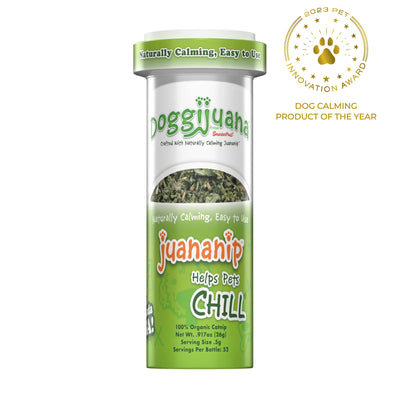
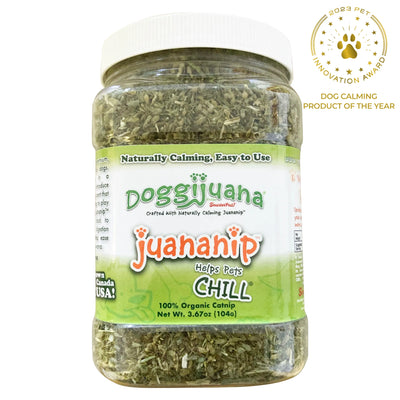
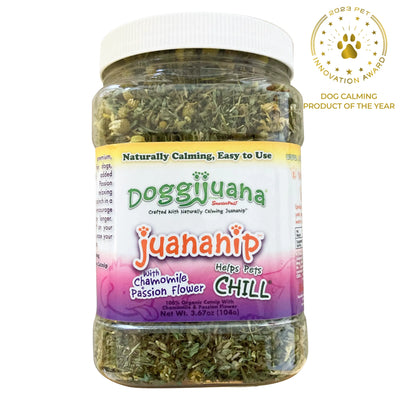
The calming effect from ingested catnip tends to be more pronounced and longer-lasting than from scent alone. This is why Juananip can be sprinkled on food as well as used in toys.
Need Extra Calm?
The Scent Enrichment Dimension
There's a second mechanism at work when a dog engages with a catnip-enriched toy that's independent of any specific botanical effect: scent enrichment itself is neurologically calming.
A dog's olfactory system connects directly to the limbic system — the emotional brain — and to the parasympathetic nervous system. Nose work (sniffing, investigating, tracking scent) activates the parasympathetic system, which is the body's rest-and-digest mode. It counteracts the sympathetic fight-or-flight response. A 2019 study in Applied Animal Behavior Science found that dogs who participated in regular nose work showed significantly more optimistic behavior than dogs in conventional obedience training — a direct indicator of improved emotional state.
This means that a Juananip-enriched toy produces two overlapping calming effects: the botanical sedative effect of the catnip itself, and the parasympathetic activation that comes from the act of investigating an interesting scent. These effects reinforce each other, which is why the toy format is particularly effective compared to scent alone.
Juananip Bites
Is Catnip Safe for Dogs?
Yes. Catnip is non-toxic to dogs at appropriate doses. It contains no compounds harmful to canine physiology — no THC, no alkaloids, no compounds that accumulate or cause organ damage. VCA Animal Hospitals, the ASPCA, and major veterinary organisations all classify catnip as safe for dogs.
Large amounts of catnip ingested at once can cause mild digestive upset — loose stools, stomach gurgling — but this resolves quickly and doesn't occur with the small amounts used in Juananip applications. A pinch in a toy or on food is well within any dog's safe tolerance.
Catnip is also rich in magnesium — a mineral that supports nervous system function — and vitamins C and E. Its nutritional profile makes it a great ingredient to use regularly.
Why Not All Dogs Respond — And What to Do
If your dog doesn't visibly respond to straight catnip, a few things are worth trying before concluding they're a non-responder. First, try the ingested format — sprinkle Juananip on food rather than relying on scent alone. Second, give it time — some dogs show a more muted response on first exposure and become more responsive with familiarity. Third, try a fresh batch — the potency of catnip degrades with age and exposure to air.
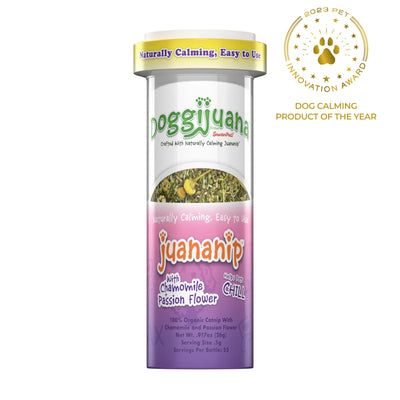
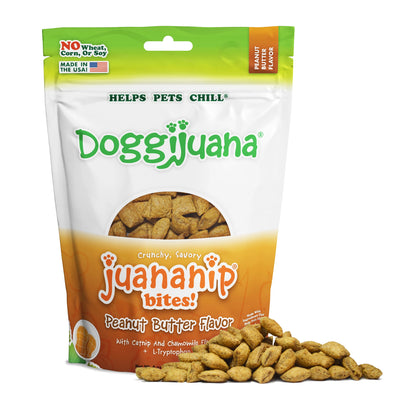
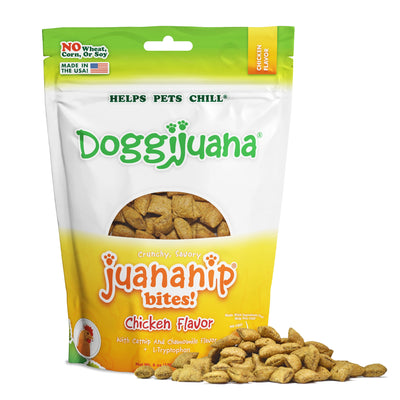
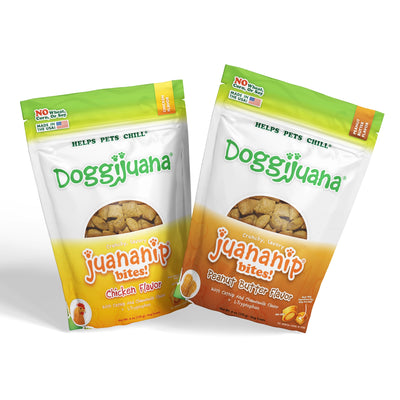
If your dog genuinely doesn't respond to catnip, the Chamomile & Passion Flower blend — which targets the GABA pathway independently of catnip's nepetalactone mechanism — is the better option. Chamomile's apigenin and passionflower's chrysin work regardless of how a dog's vomeronasal system processes catnip. And Juananip Bites, with L-tryptophan for serotonin support, operate on a completely different pathway again.
For the full guide to scent-driven play for dogs and how it connects to both enrichment and anxiety management, read our pillar: Scent-Driven Play for Dogs: The Complete Guide.
Doggi Duos

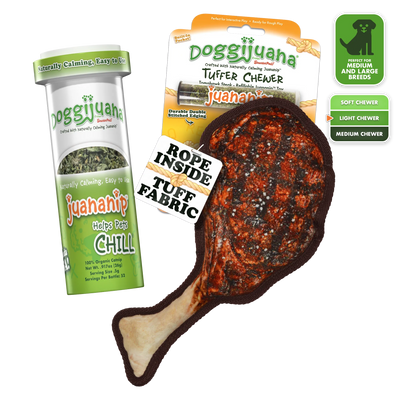

That's the science half of the story. For the practical half (how much is safe, what the dog version of catnip actually is, how long a session lasts, and how to use it day to day), our complete catnip-and-dogs guide picks up where the neurology leaves off, and if calming is the goal you came in with, the calming guide goes straight there.


