


The name is the first source of confusion. "Cat thyme" isn't the thyme in your spice rack. It's a different plant, in a different botanical family, with a different set of compounds, that happens to share a common name because of what it does to cats. If you've been searching for whether the thyme growing in your herb garden is safe for your cat, you've probably been mixing two different conversations. This post separates them.
What we'll cover: what cat thyme actually is, why it works on cats (including cats that don't respond to catnip), whether culinary thyme is safe as a related question, how to use dried cat thyme sprigs, and how it fits alongside catnip, silvervine, and valerian in the wider herbal-response picture.
Cat thyme vs. culinary thyme: two different plants
The confusion is worth clearing up first because it changes almost every answer downstream.
Culinary thyme is Thymus vulgaris. Mediterranean origin, mint family (Lamiaceae), small green leaves, warm savory smell. This is the thyme in every spice rack and every roast chicken recipe. Most cats find it uninteresting or mildly off-putting because of the strong volatile oils, and while it's not toxic in small amounts, it's not a herb cats seek out or respond to behaviorally.
Cat thyme is Teucrium marum. Also called "cat germander" or "herb mastich," it's a low, woody Mediterranean shrub in the same mint family but a completely different genus. The smell is musky, almost unpleasant to most humans (it's often described as smelling like sweaty socks or musky sage). Cats, on the other hand, tend to have a strong reaction to it. Some rub against it, roll on it, and act catnip-drunk. Others ignore it entirely. The response profile is similar to catnip's, but the plant is different.
The two plants share a common name because both smell "thymey" to humans in their own way, and both were catalogued informally by herbalists who noticed that one of them (Teucrium marum) had a striking effect on cats. Somewhere along the way, "cat thyme" stuck as the common name, and the confusion followed.
For the rest of this post, "cat thyme" means Teucrium marum. When we mean the culinary herb, we'll say "culinary thyme."
What cat thyme does for cats
Cat thyme contains a compound called dolichodial (and related iridoid glycosides) that appears to trigger a response in cats similar to what nepetalactone triggers in cats that respond to catnip. The behavioral picture looks about the same: rubbing, rolling, purring, some drooling, occasional zoomies. The intensity varies by cat, and the duration is typically around five to fifteen minutes before the response fades and the cat becomes temporarily desensitized (the same refractory period you see with catnip).
The interesting part is which cats respond. Around 30% of cats don't respond to catnip at all. It's a genetic trait, essentially binary: either your cat has the receptor sensitivity or it doesn't. Cat thyme is one of a handful of herbs (silvervine and valerian are the other two most studied) that activates a somewhat different set of receptors. A cat that ignores catnip may respond strongly to cat thyme.
This is why cat thyme keeps showing up in serious catnip-alternative discussions. It's not just a substitute; it's a genuinely different chemistry. Cats that get nothing from catnip sometimes get a full response from cat thyme. Cats that love catnip may respond less dramatically to cat thyme, since some of the same receptor pathways are already familiar. The takeaway: cat thyme is most valuable for the cats who are missing out on the catnip experience.
Is cat thyme safe for cats?
Yes, in the dried form, at the amounts cats can realistically consume.
Cat thyme has a long history of use as a feline enrichment herb, both in commercial products (dried sprigs, sachets) and in home gardens. Toxicity data on Teucrium marum specifically is limited, but the plant is considered safe for cats at the amounts used in dried-herb products. The ASPCA doesn't list Teucrium marum among plants toxic to cats.
Two safety notes worth knowing:
Some Teucrium species have concerns. Not all germanders (the wider Teucrium genus) are the same. Wall germander (Teucrium chamaedrys) has been associated with liver stress in humans at high therapeutic doses. This isn't the same species as cat thyme, and the concern is at concentrated extract doses, not at the trace amounts cats would encounter from dried sprigs. Still, if you're sourcing cat thyme, buy from a reputable pet product supplier that uses Teucrium marum rather than a random garden nursery selling generic "germander."
Essential oils and concentrated extracts are a different conversation. As with every herb we cover, the dried form is forgiving and the concentrated forms are not. Cats' livers process terpenes and volatile oils slowly, and concentrated cat thyme oil (rare, but it exists in some herbal extracts) is not appropriate for cats. Stick with dried sprigs or dried loose herb. Skip any product labeled as an essential oil or tincture unless it's specifically formulated for cats by a veterinarian.
The pattern we come back to in every herbal post applies here too: dried form, small amount, no essential oils. Our lavender for cats guide covers the dried-versus-oil principle in depth if you want the fuller framework.
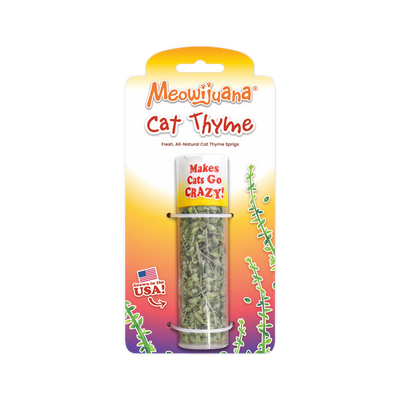
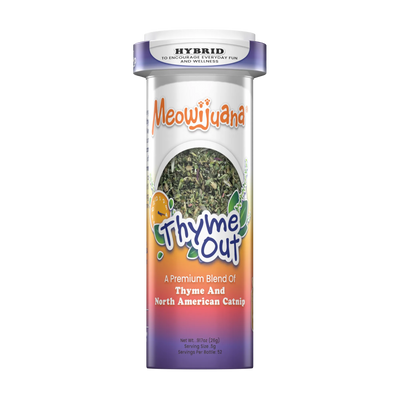
For at-home use, the dried sprigs are the simplest starting point: one herb, immediate interaction, easy to gauge your cat's response before committing further. If you already know your cat responds and want a blended option designed for regular use, Thyme Out pairs cat thyme with complementary herbs in a ready-to-use format.
Cat thyme for at-home use
Can cats have culinary thyme?
Since the naming confusion sends a lot of people here for the wrong reason, this section covers the other conversation.
Culinary thyme (Thymus vulgaris) is not toxic to cats in the amounts they'd realistically consume. A leaf nibbled off a garden plant, or a small amount stuck to a piece of meat from a family meal, is fine. There's no serious toxicity concern at food-scale exposures.
The reasons culinary thyme isn't recommended for regular use aren't about toxicity — they're about compatibility. Culinary thyme contains higher levels of thymol and carvacrol (the strong-smelling volatile oils that give it the savory flavor humans love). Cats' livers process these compounds slowly, so large consumption of raw thyme leaves can cause mild GI upset over time. In practice, most cats won't consume enough to reach that threshold because they don't like the taste.
The bigger issue is that culinary thyme essential oil is a real concern. Diffused thyme oil, thyme oil in cleaning products, or thyme-based flea treatments (some natural-flea products use thymol as an active ingredient) can accumulate to problematic levels for cats over time. This isn't about a cat licking a thyme leaf. It's about ambient exposure to concentrated thyme oil in a household with cats.
So the short answer on culinary thyme: mostly fine as an occasional garden nibble, not a herb to feature on purpose, and worth avoiding in essential-oil form. And to be clear: culinary thyme doesn't produce the behavioral response that cat thyme does. If you've been offering your cat sprigs from your kitchen thyme plant hoping for the catnip-like reaction people describe, that isn't going to happen. You want Teucrium marum, sold as "cat thyme."
How to use cat thyme at home
The dried sprigs are the simplest starting point. A whole dried sprig of cat thyme in a cat-safe spot on the floor gives a cat something to sniff, rub against, roll on, and gently chew. Some cats will pick up a sprig and carry it around. Others will hunker down and rake with their back paws the way they do with a kicker toy. The reaction is unpredictable until you've watched your cat respond once or twice.
A few practical notes:
- Start with a single sprig. One sprig is enough for a solid session. You can pull off individual small pieces for lower-key introduction if you want to gauge the response.
- Rotate exposure. Like catnip, cat thyme response fades with too-frequent exposure. Once or twice a week keeps the novelty and the response strong. Daily use dulls both.
- Store the sprigs airtight. Dried herbs lose their volatile compounds quickly when exposed to air. Keep unused sprigs in a sealed container so the third sprig you offer is as potent as the first.
- Don't be surprised if your cat carries it off. The stalking-and-hauling behavior is common with cat thyme, more so than with catnip. Cats often want to take the sprig somewhere private, which is normal.
- Watch the drool. Some cats drool more with cat thyme than with catnip. It's not a sign of distress, it's a sign the response is working.
If you have a cat that has never shown a catnip reaction, cat thyme is one of the more promising things to try. The typical experiment: give your cat a dried cat thyme sprig, watch for ten minutes, and see what happens. Either you'll get a strong response (in which case you've found your cat's herb) or you'll get nothing (in which case silvervine is the next best thing to try).
Cat thyme vs. silvervine vs. valerian: which herb for which cat
Cat thyme is one of four commonly-used cat-response herbs. Each activates a somewhat different set of receptors, and the response profile differs a bit across them.
Catnip is the baseline. Around 70% of cats respond, ranging from mild to strong. The response is 5–15 minutes of rolling, rubbing, drooling, sometimes zoomies, followed by a refractory period of 1–2 hours.
Silvervine catches a lot of the cats that catnip misses. Roughly 80% of cats respond to silvervine, and this includes many of the 30% who don't respond to catnip. The response is often more intense than catnip's, with more physical activity and shorter duration. Our silvervine effects on cats guide covers this in depth.
Valerian is the wild card. Roughly 50% of cats respond, and the response varies wildly, from euphoric play to unusually calm nap-inducing settling. Some cats hate the smell and avoid it entirely. Our valerian root vs. catnip comparison walks through when to reach for each.
Cat thyme is the least-studied of the four but has a real following among catnip non-responders. The response profile is closest to catnip, but the receptor pathway is different enough that many catnip-indifferent cats respond well.
A practical order to try herbs with a new cat, or a cat you haven't figured out yet: catnip first (widely available, cheap to test), silvervine second (if catnip gets no response), cat thyme third (a further alternative), valerian fourth (last resort because of the smell and the unpredictable response). Most cats respond to at least one of the first three.
For the full picture on what to try when catnip doesn't work, our calming herbs for cats guide covers the wider set of options and how they fit together.
Signs cat thyme is working (or not)
A cat that's responding to cat thyme will show one or more of the following inside a few minutes of exposure:
- Rubbing the face and cheeks against the sprig. This is the scent-marking behavior triggered by the compounds in the herb.
- Rolling. Full-body rolling, often with the cat wrapping around the sprig.
- Chewing or licking. Some cats will gently chew the woody stems.
- Drooling. More common with cat thyme than with catnip. Not a concern.
- Bunny-kicking or hind-paw raking. The classic prey-play motion, applied to the sprig.
- Vocalization. Some cats trill, chirp, or make hunting-adjacent sounds.
- Zoomies afterward. Some cats sprint around the house immediately after the response fades.
A cat that isn't responding will sniff, walk away, or briefly interact and then lose interest. That's just how the genetics fall out. It's worth trying a fresh sprig on a different day (freshness matters), but if two attempts with fresh cat thyme produce no response, your cat is probably a cat thyme non-responder.
How cat thyme fits in the wider herbal picture
Cat thyme belongs to a small family of herbs that produce a behavioral response in cats through natural volatile compounds. The others are catnip, silvervine, valerian, and to a lesser extent Tatarian honeysuckle and lemongrass (which some cats respond to mildly).
All of them work through a similar general mechanism: aromatic compounds interact with olfactory receptors, which trigger a cascade of behavior related to scent marking, prey response, and pleasure. None of them are drugs in the pharmaceutical sense. None are addictive, dependency-forming, or dangerous at the amounts cats realistically consume. They're natural plant compounds that happen to line up with cat neurochemistry.
What makes cat thyme worth keeping in the rotation: it activates a receptor set slightly different from catnip's, which means it's useful for cats that miss out on the catnip experience, and for cats that could benefit from herbal variety after weeks of catnip use has started to dull the response.
If you're building a herbal-variety rotation for a cat that responds to multiple herbs, our safe herbal stimulants for cats guide covers how to schedule exposure across different herbs to keep each response fresh.


