


Anxiety in dogs is more common than most owners realize, and most "natural remedies" you'll find online are either overhyped or under-explained. The herbal supplement that promises to fix everything almost never does. The hundred-dollar calming bed isn't what your dog needed. The most effective natural remedies aren't usually the ones being marketed the hardest.
Here are the eight that genuinely work for the right kind of anxiety, what each one is best for, and when natural remedies aren't enough, because sometimes they aren't, and that's worth being honest about.
First, figure out what kind of anxiety you're dealing with
The biggest reason "natural remedies" disappoint is that the remedy didn't match the type of anxiety. Some natural approaches are great for situational anxiety and useless for clinical anxiety. Others work for sound anxiety but not for separation. Treating it all as one thing is the trap.
The four broad categories most household dogs fit into:
- Separation anxiety. Triggered by being alone, or perceiving they're about to be left alone. Pacing, panting, destructive chewing near doors, vocalizing. Builds even when you're getting ready to leave.
- Sound or storm anxiety. Triggered by fireworks, thunder, construction noise, sometimes wind. Hiding, trembling, refusing to eat. Predictable seasonal spike in late June and on July 4.
- Generalized anxiety. Always-on baseline of unease. Hypervigilance, restlessness, can't seem to settle even when nothing's happening.
- Situational anxiety. Vet visits, car rides, grooming, meeting new dogs. Anxiety that's tied to specific predictable events.
Different anxiety types respond to different remedies. Sound anxiety responds well to scent enrichment, music, and predictable safe spaces. Separation anxiety responds to routine, gradual desensitization, and (sometimes) calming treats given before departure. Generalized anxiety often needs the bigger picture: exercise, routine, sometimes medication. Knowing which one you're working with makes the rest of this list usable instead of guesswork.
If you're not sure where your dog fits, our signs of anxiety guide walks through the symptom patterns, and the calming an anxious dog pillar covers the larger framework.
Catnip for dogs (yes, that's a thing)
Most dog owners don't know that catnip and dogs are a real combination. The mechanism is just different from cats.
Cats respond to nepetalactone (the compound in catnip) by entering a stimulating, sometimes goofy state. Dogs respond to a related compound, actinidine, with a calming effect. Same plant family, different metabolism, opposite outcome. The cat is wired up; the dog mellows out.
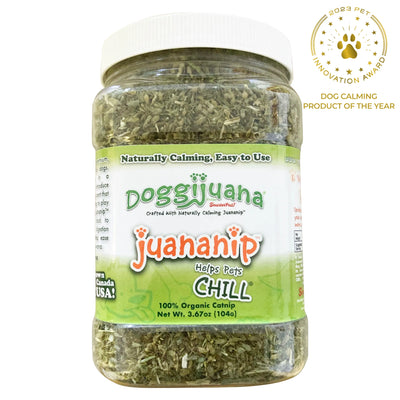
This is the entire premise of Juananip, our catnip-for-dogs line. The plain version is 100% Canadian catnip, the same grade as our cat blends, formulated for sprinkling on a dog's bed, toys, or food. The chamomile-and-passion-flower variant (which we'll get to in the next section) layers two more calming herbs on top.
Honest caveats:
- Not all dogs respond. About 30 to 40% of dogs are non-responders, similar to the catnip non-responder rate in cats.
- The effect is calming, not sedating. Don't expect your dog to be knocked out. Expect "settled."
- Best results when used proactively, not reactively. Sprinkle it 20 to 30 minutes before the anxiety trigger (fireworks, guests arriving, vet visit) rather than during the event.
If you've never tried it, the trial pack is the lowest-risk way to see if your dog responds.
Juananip for dog anxiety


Chamomile and passion flower (the calming combo)
Chamomile and passion flower are two of the best-supported calming herbs in herbal medicine. The mechanisms translate well from human research to dogs. Chamomile (Matricaria chamomilla) has mild sedative properties through apigenin, a compound that binds to GABA receptors. Passion flower (Passiflora incarnata) works through chrysin, which has documented anxiety-reducing effects in animal studies.
Combined, they're synergistic. The calming effect is greater than either one alone. That's the formulation behind our Juananip with Chamomile and Passion Flower variant, which adds both herbs to the same catnip base in supportive amounts well within the safe formulation range for dogs.
When to reach for the combo over plain Juananip:
- Your dog has tried plain Juananip with mild response. The chamomile-passion-flower layer can push the effect from "settled" to "actually calm."
- Anxiety types where pure catnip-calming isn't enough: generalized anxiety, harder separation-anxiety cases.
- Situational anxiety where you want the strongest natural option before reaching for vet meds.
The Juananip Bites are the treat format of the same formulation. Easier to give in the moment, easier to dose precisely (one to three bites depending on dog size), and dogs treat them as a reward rather than as medicine.
Calming combo treats and refills



Exercise (the most underrated remedy)
This isn't sexy advice but the data is overwhelming: anxious dogs are very often under-exercised dogs.
The mechanism is straightforward. Physical exercise burns off stress hormones (cortisol, epinephrine) and depletes the energy that fuels hypervigilance. A dog who got 45 minutes of focused activity in the morning has a lower anxiety baseline at 5 PM than a dog who got a 10-minute walk around the block.
The bar most dogs aren't meeting: 30+ minutes of focused daily activity. Not slow leash walks (those are bathroom breaks, not exercise). Real movement: fetch, running, swimming, dog park play, scent work with motion.
Dogs that need more than this: working breeds (border collies, retrievers, German shepherds, Belgian malinois), young dogs (under 4), and dogs from high-energy lines regardless of breed. For high-energy dogs the rule is closer to 60+ minutes daily. Hitting that number resolves a meaningful percentage of "anxiety" that turns out to be unmet exercise need.
It's worth ruling out before stacking remedies. A tired dog is a calm dog, and no amount of chamomile fixes an under-exercised one.
Scent enrichment (the snuffle effect)
Sniffing reduces cortisol in dogs. There's good research on this. When dogs engage their nose for sustained periods, their stress hormones measurably drop. The effect lasts hours after the activity ends.
Practical applications:
- Snuffle mats: fabric mats with hidden treats. Cheap, low effort, surprisingly effective.
- Scent work games: hide treats around the house and let your dog find them.
- Refillable scent toys: toys with refillable scent pockets that let your dog work to extract the catnip or treats.
- Food puzzles: turn meals into nose-work.
Our Tuffer Chewer toy line works well for this. They're refillable, so you load Juananip inside the toy and your dog has to work it out. Fifteen minutes of focused chewing and nose-work can do more for an anxious dog than a 30-minute walk.
Best for: separation anxiety (especially with the toy left during your departure), sound anxiety (sniff sessions during storms), and as part of generalized anxiety management.
Routine, weighted comfort, and music
Three lifestyle remedies that bundle well because they all work on the same underlying mechanism: predictability.
Routine. Dogs are pattern matchers. A predictable daily schedule (meals at the same times, walks at the same times, sleep schedule stable) reduces anxiety baseline measurably. The dog who knows what's happening next is less anxious than the dog who doesn't. This sounds obvious; most owners still don't do it consistently.
Weighted comfort. Thundershirts and weighted blankets work via gentle pressure on the chest and torso, which activates the parasympathetic nervous system (the calming half of your dog's autonomic nervous system). Effective for 30 to 50% of dogs with sound and storm anxiety. Cheap to try.
Music. Specific frequencies and tempos have measurable calming effects on dogs. Classical music outperforms other genres in studies, and there are specific "dog calming" playlists designed using the research. Useful as a background during anxiety triggers: playing during fireworks, during car rides, when you leave the house. White noise serves a similar function for sound-anxious dogs.
These won't single-handedly fix severe anxiety, but stacked together they raise your dog's baseline calmness without any active intervention required.
CBD for dogs (our honest take)
We don't sell CBD products. Here's why: the research isn't there yet.
What's known: CBD has documented anti-anxiety effects in humans and in some animal studies. Some dog owners report meaningful results. The compound itself isn't acutely dangerous at typical doses.
What's not known with confidence: long-term safety in dogs, optimal dosing protocols, drug interactions with common veterinary medications, and how dramatically the unregulated supplement market affects what's actually in any given CBD product. A 2020 review of dog CBD products found enormous variance in actual cannabidiol content versus what was labeled. Some products had a tenth of the claimed amount; some had multiples; some had THC contamination that's not safe for dogs.
If you're considering CBD for your dog: talk to your vet first, source from a brand with third-party COA (Certificate of Analysis) testing, and start at a much lower dose than the label suggests. We'd rather hold off on the category until the evidence and product quality are more reliable.
When natural remedies aren't enough
This is the section most "natural remedies" posts skip, which is a disservice. Some dog anxiety is a clinical condition that needs more than herbs and routine.
Signs natural isn't enough:
- Symptoms persist or worsen after weeks of consistent natural management
- Self-harm behaviors (excessive licking causing wounds, tail-chewing)
- Panic attacks (sudden intense episodes with no clear trigger)
- Destructive behavior that endangers the dog (escaping confinement, breaking through doors)
- Refusing to eat for more than 24 hours due to anxiety
- Aggression directly linked to anxiety triggers
If any of these describe your dog, talk to your vet about prescription options. Common veterinary anti-anxiety medications include trazodone (situational, often used for fireworks and vet visits), gabapentin (sound-trigger, situational), fluoxetine (chronic, takes weeks to build effect), and alprazolam (acute panic, used short-term).
This isn't a failure. Anxiety is a clinical condition for some dogs, and treating it that way doesn't mean you've given up on the natural side. Most dogs do best with both. The Juananip-and-routine work continues; the medication addresses the part the natural side can't reach.
For seasonal context: late June through early July is the worst stretch for sound-anxiety dogs in most of the US. If your dog has firework anxiety, the how to calm a dog during fireworks guide covers the event-specific playbook in depth.


