


Most senior cats aren't bored because they've lost interest in life. They're bored because the enrichment options around them are still designed for a three-year-old sprinting up a cat tree. A 12-year-old cat has different joints, a slightly different brain, and a different pace. Match the enrichment to the cat, and most senior cats stay curious, engaged, and surprisingly playful well into their golden years.
Why older cats still need stimulation (and what happens when they don't get it)
Cognitive decline in cats isn't hypothetical. Feline cognitive dysfunction syndrome (FCDS) is a real condition, similar to early dementia in humans, and it affects an estimated 28% of cats aged 11 to 14, with that number climbing to over 50% in cats 15 and older. Regular mental and physical stimulation is one of the few evidence-backed tools for slowing its progression.
Even without cognitive concerns, a cat that stops playing, stops exploring, and stops interacting tends to decline faster. Joints stiffen faster without regular use. Muscle mass drops faster without activity. The enrichment you provide isn't just entertainment for a senior cat. It's part of how they stay healthy.
The catch is that the enrichment has to be designed for where they are, not where they were at three years old.
How senior cat enrichment is different from adult cat play
Three shifts happen when you cross into senior territory. Session length: an adult cat can sustain focused play for 10 to 15 minutes. A senior cat's comfortable window is typically 3 to 5 minutes, sometimes less for cats 15 and older. Stopping before the cat disengages keeps the session feeling positive. A cat pushed past the point of engagement learns to avoid the toy.
Movement mechanics matter too. Arthritis affects roughly 90% of cats over 12, with most owners unaware because cats mask pain well. Ground-level play (wand toy moved low and slow instead of high and fast) lets a senior cat engage fully without needing to jump, reach overhead, or torque a sore hip.
Catnip response also changes. Some senior cats stay enthusiastic. Others shift from active playing to passive sniffing and cheek-rubbing. Both are valid, and the passive response opens up a whole category of enrichment that doesn't require physical activity at all.
Physical enrichment: short sessions, ground-level engagement
For senior cats that are still mobile, the goal is to preserve that mobility through regular short sessions rather than occasional long ones. Wand toys work well for seniors when used correctly. Bring the toy to the ground. Move it slow. Think "injured prey" more than "frantic fly." A senior cat that can stalk, approach, and catch a slow-moving toy gets the full prey-sequence satisfaction without needing to leap or sprint.
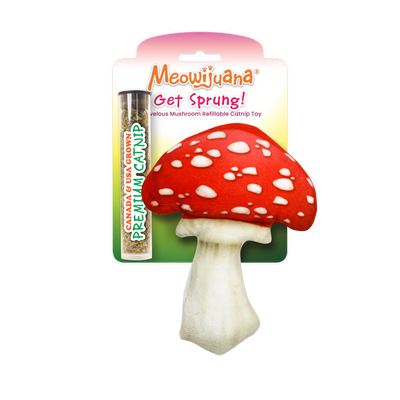
Meowijuana's Get Sprung! Refillable Mushroom is a good fit here. It's soft, low-drag, and light enough that a cat can carry and chew-scent it after the catch, which extends the enrichment beyond the active chase. Adding a spritz of Meowijuana Catnip Spray to the toy right before a session re-engages a cat that's starting to lose interest in a familiar toy. A quick spray, a five-minute wait, and the toy smells new again. The catnip spray guide covers technique and timing in full.
Three to five minutes every day beats a 20-minute session once a week. Frequency matters more than duration for maintaining range of motion and mental sharpness.
Mental enrichment: puzzles and scent work for lower-mobility cats
Once a cat starts showing stiffness or avoiding jumping, the focus shifts from physical play to cognitive stimulation. Treat dispensers are particularly well suited to senior cats because they deliver mental engagement (figuring out the dispenser) and a food reward (motivating even low-energy cats) without requiring athletic movement.
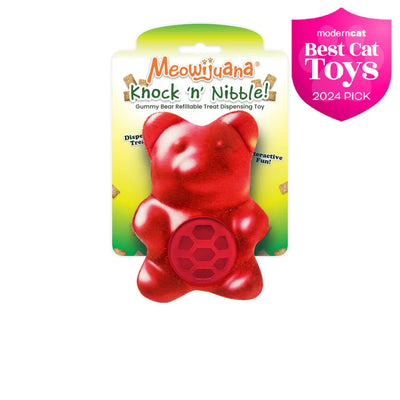
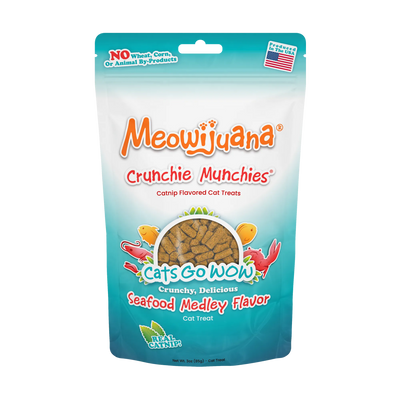
The Knock 'n' Nibble Gummy Bear works well at this life stage because the dispensing mechanic is low-effort: bat or nudge the toy, treats fall out. It's forgiving for cats with arthritis in their paws. Load it with Meowijuana Crunchie Munchie Seafood treats and the scent alone draws in cats who might not engage with a toy on its own.
Scent-swapping is another underused tool. Rotating different Meowijuana blends onto familiar spots (a sleeping pad, a scratcher, a flat toy) once a week gives a cat new olfactory information to process without requiring any physical exertion. A familiar object that suddenly smells different becomes interesting again.
Play and Enrichment for Senior Cats

Passive enrichment: stimulation that requires nothing from the cat
Passive enrichment gets overlooked because it feels too easy. But for geriatric cats (15+) or cats that are mostly sedentary regardless of effort, passive approaches are often the most effective because they meet the cat where they are.
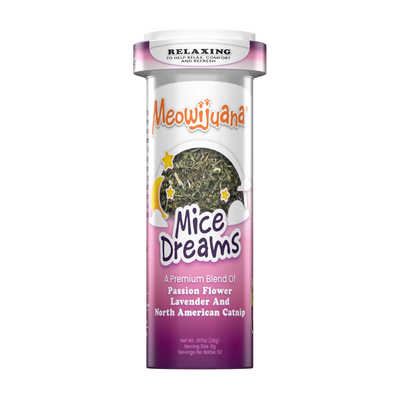
Catnip spray on a blanket or low perch gives a cat continuous scent exposure without any activity requirement. The cat sniffs, rolls, rubs a cheek, and gets the sensory experience on their own terms. Meowijuana Mice Dreams is particularly well-suited to passive enrichment because it's a relaxing blend, which means the response tends toward calmer cheek-rubbing and soft rolling rather than frantic activity. A small amount of loose Mice Dreams in a flat dish near a resting spot gives a cat something to investigate from a comfortable position. (Catnip generally runs well below the 2% safe-formulation ceiling for botanicals, so regular exposure is fine for most adult cats. More on what catnip actually does is on the catnip overview page.)
Window enrichment is free and often underestimated. A bird feeder positioned at eye level to a low perch gives a cat a reason to look up from where they already are. No elaborate cat-tree setup needed. A low perch with a feeder visible through the glass covers visual enrichment for hours.
Putting it together: a senior cat enrichment routine
The best routine is the one you'll actually do. For most senior cats, this looks like one 3-to-5-minute active session per day (wand toy for mobile cats, treat dispenser for cats with stiff joints), a weekly scent-swap on one familiar spot using a different Meowijuana blend, and an ongoing window setup for passive visual enrichment.
If your cat disengages early during a session, stop and try again later rather than pushing through. Senior cats that end sessions on a successful catch or a satisfying sniff stay more engaged over time than cats that are pushed until they give up and walk away.
If your senior cat seems completely disinterested in their environment, including food smells and familiar people, that's worth a vet conversation. Pain, thyroid changes, and early cognitive dysfunction are all very treatable when caught early. Enrichment is powerful, but it works best alongside a vet relationship that catches what enrichment alone can't fix.


