


A dog with too much energy and too little to think about will find its own entertainment. Usually something you own. Mental stimulation isn't a luxury, it's maintenance. A well-exercised brain slows a dog down as much as a long walk, and puzzle toys are one of the most practical ways to deliver it.
The problem is most owners buy a puzzle toy, watch their dog ignore it after three minutes, and conclude their dog just isn't interested. Usually the toy is the wrong difficulty level. Either it's too easy and the reward comes too fast to hold attention, or it's too hard and the dog gives up before connecting effort to payoff.
What chew difficulty actually means (and why it matters more than you think)
Puzzle toys split into two categories, and most owners only think about one of them.
Treat-dispensing toys like the Doggijuana Snack Slinger Breakfast Toast are fill-and-work puzzles: load treats inside, and the dog figures out the mechanism to get them out. The difficulty here is about the complexity of the dispensing action — how the dog needs to nose, tip, or paw the toy to release a treat. These work well for any size and chew style, and they're one of the best options for feeding a meal through enrichment rather than a bowl.
Chew-resistance toys are about material hardness and sustained jaw engagement. The challenge isn't a mechanism to solve once — it's a sustained gnaw session where the dog works for a payoff over 10 to 30 minutes. These are tier-dependent: the wrong material for your dog's chew intensity either disappears in minutes (too soft) or never rewards them at all (too hard).
Both types count as enrichment. The difference is what kind of work you're asking your dog to do. Dispensers build nose-and-paw problem-solving. Chew toys build calm, sustained focus. A good daily plan uses both.
Puzzle toys aren't just about the treat hidden inside. They're about resistance, the time between effort and reward. A toy that pays off in under 30 seconds isn't really a puzzle. A toy that never pays off teaches the dog that effort is useless. You're looking for the middle: sustained engagement that ends in a clear win.
Difficulty for chew toys breaks down into a few variables: the hardness of the material, the complexity of the mechanism (locking, sliding, layered), and the size relative to the dog's jaw. Material hardness matters most. A toy designed for a 10-pound dog that a 60-pound power chewer is working through in four minutes isn't enriching. It's just a snack.
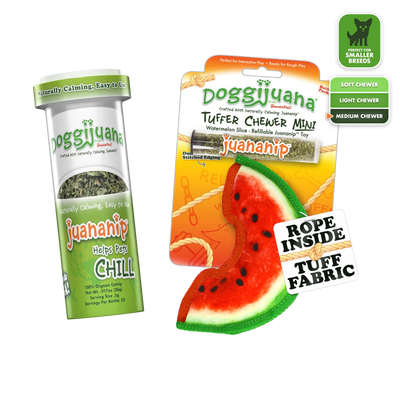
Starter level toys work for puppies, seniors, and light chewers. The goal at this level isn't challenge, it's building the association between the toy and positive outcomes. Softer materials, shorter engagement windows (5 to 10 minutes), and easy payoff. The Tuffer Chewer Mini Game Day Duo in Watermelon is a good fit here: a smaller, more manageable size that gives lighter chewers enough to work but doesn't frustrate them.
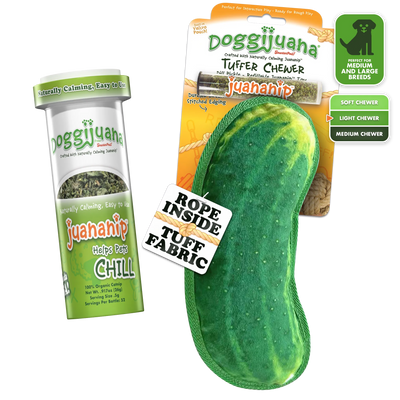
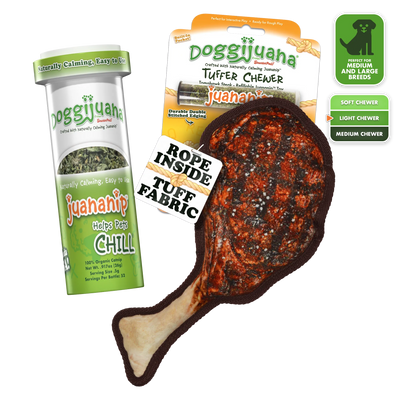
Standard level is where most adult dogs land. Moderate material resistance, sustained engagement, flavors that stay interesting. The full-size Tuffer Chewer Game Day Duos (Dill Pickle and Tomahawk Steak) are built for this tier. Dogs who stay engaged for 10 to 20 minutes before getting bored are in this category. Rotating flavors keeps the novelty up over time.
Challenge level is for power chewers who demolish softer toys immediately. These dogs need heavy material resistance and constant supervision. No toy is indestructible, and a power chewer working through a toy faster than intended can create pieces large enough to swallow. The Tomahawk Steak Tuffer Chewer handles power chewers well, but watch the session and pull the toy when it starts to break down.
How Juananip Bites fit into a puzzle toy routine
The role of Juananip Bites is different depending on the toy type, and mixing those up is one of the more common mistakes.
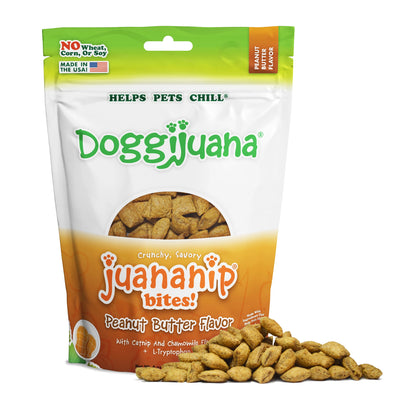
With the Snack Slinger, Juananip Bites go inside. Load them in and the dog works the dispensing mechanic to get them out. The treat is the payoff for solving the puzzle. This is what a treat-dispensing toy is designed for.
With the Tuffer Chewer, Juananip Bites are an external reward — given before a session to build anticipation, or after a session as a reinforcer. You're pairing the calm, focused state that follows a good chew session with a treat. Over time that association makes your dog more likely to engage with the chew toy when you offer it. They're not going inside the chew toy.
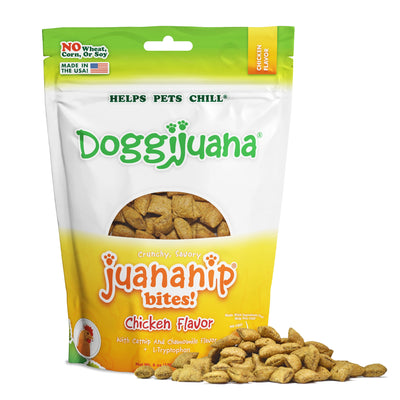
Chicken and Peanut Butter flavors give you variety. Rotating flavors is the same principle as rotating puzzle toys: novelty extends engagement.
The Doggijuana Puzzle Line

Building a daily enrichment plan that actually holds
The reason most enrichment plans fail is that they're designed for a Pinterest board, not a real schedule. Here's a realistic structure that works whether you're home all day or out for most of it.
Morning: Skip the bowl. Feed breakfast through a puzzle toy — the Snack Slinger Breakfast Toast works well here because the dispensing mechanic slows eating down and adds problem-solving work before the day starts. This adds 10 to 15 minutes of focused mental work at the start of the day when dogs are freshest and most driven. Follow with a short training session using Juananip Bites as reward, then a sniff walk or short play session before you leave. A dog who has already solved something and had a walk is dramatically calmer in the crate than one who went straight from sleep to confinement.
Midday (if your dog is home alone): Leave a Tuffer Chewer or frozen puzzle toy as a self-entertainer. If you're home, a five-minute training session with Juananip Bites is enough to break up a long resting stretch. Novelty matters here: whatever you use at midday should be different from the morning toy.
Evening: Give back the energy with active play or a longer walk before settling in. Then introduce the Tuffer Chewer. A dog whose body is tired will engage with a chew toy more calmly than one with pent-up energy. Juananip Bites as a final reward before bed closes the day on a calm, positive note and builds a sleep association over time.
You don't need an elaborate rotation. You need a predictable sequence your dog can anticipate. Dogs settle faster when they can predict what comes next.
When the toy isn't the problem
Short engagement time doesn't always mean wrong difficulty. Sometimes the timing is off. A dog who comes to the toy already overstimulated (just returned from a chaotic dog park, household full of guests) won't engage the way they would 30 minutes post-walk when arousal is lower.
Try introducing the toy after physical exercise rather than before. For the Snack Slinger, load it with Juananip Bites so there's immediate scent motivation from the first sniff. For the Tuffer Chewer, give a Juananip Bites treat right before handing it over to build anticipation. And try shorter, successful sessions rather than leaving the toy out indefinitely. A toy left out all day becomes invisible to most dogs. Scheduled access makes it an event.
If you're working on calming anxious behavior alongside enrichment, the fireworks calming guide has a useful breakdown of arousal timing and how to structure the approach. And if your dog's reaction to Doggijuana treats surprises you, there's a lot more on how dogs actually respond to catnip compounds in the dogs-and-catnip deep dive.
The goal isn't an exhausted dog. It's a satisfied one: one who worked for something, solved something, and ended the session with a treat. That's what the right puzzle toy at the right difficulty level actually delivers.


