


The search usually happens somewhere around the third 3 AM chaos session, or the first shredded couch cushion: "calming treats for puppies." It's one of the most-searched phrases in the dog world, and it deserves a more honest answer than the product aisle gives it. So here's the whole picture: when calming treats genuinely help a puppy, when the real fix is something else entirely, and what to know before anything new goes into a very young dog.
Is your puppy anxious, or just a puppy?
This is the question that sorts everything downstream, because the two look identical at 9 PM. Normal puppy behavior includes evening zoomies, mouthing everything that exists, destruction of unattended objects, and a sleep-crash-chaos cycle that repeats all day. None of that is anxiety; it's a young working animal with a motor and no job. Actual anxiety looks different: prolonged distress when left alone (not just protest barking, but sustained panic), trembling or hiding from ordinary things, appetite loss, and fear that doesn't fade as a situation becomes familiar.
The honest statistic of puppy ownership is that most "anxious puppy" searches are describing the first list, not the second. That matters because calming treats don't fix an energy surplus. Outlets do, and a puppy with enough outlets is a shockingly calmer puppy by the same evening.
What calming treats actually are (and aren't)
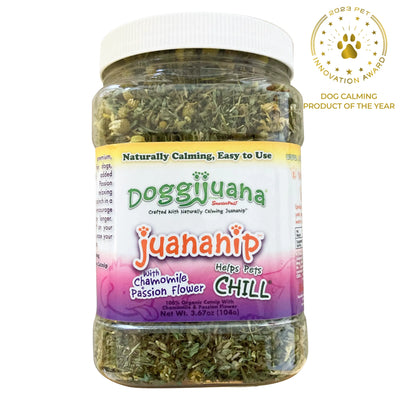
The genuine article is simple: treats carrying gentle botanicals with long histories of soft, take-the-edge-off effects, most commonly chamomile, passion flower, and valerian, sometimes alongside catnip, which works in the calming direction on dogs rather than the euphoric one it triggers in cats. What they can do is soften the edges around a known stressor: the crate at bedtime, a car ride, a thunderstorm, the vacuum's reign of terror. What they can't do is train a puppy, replace exercise, or turn a normal adolescent motor off. A calming treat is a tool for moments, not a personality adjustment.
The CBD and hemp hype check
Search this topic and the results are wall-to-wall CBD and hemp chews, so the subject deserves a straight paragraph. Whatever you make of CBD for adult dogs, puppies are a different question: dosing guidance for young, growing dogs is thin, product quality varies widely across the category, and the research on developing dogs specifically is close to nonexistent. That's not a scare line, it's just the state of the evidence, and it's why the conservative route for a puppy is gentle botanicals with long track records, introduced with your vet's blessing, rather than the strongest-sounding thing on the shelf.
The vet-first rule
Here's the rule this post actually exists to deliver: before any calming treat goes into a puppy, ask your vet. Not because the gentle botanicals are scary, but because puppies are small, growing, and weight-dosed for everything, and because "my puppy seems anxious" is occasionally a medical sentence rather than a behavioral one. A thirty-second question at a checkup covers it, and a vet who knows your puppy can tell you when to start and how much makes sense. Our calming line is formulated for dogs, and that conversation is the right gate between it and a puppy.
The Gentle Botanical Lineup


The enrichment answer that usually comes first
If the honest diagnosis was "just a puppy," the fix is a fuller schedule, and it works faster than any ingredient: scent games that make the nose do hard work (ten minutes out-tires a walk), meals fed through puzzles instead of bowls, and a predictable evening play-then-eat-then-sleep routine that aims the witching hour instead of enduring it. Our guides to brain games, puzzle toys, and scent as exercise are the full toolkit, and they're the part of this topic with no fine print at all.
When the treats do earn their place
With the vet's go-ahead and the energy outlets in place, calming treats slot into the moments framework: given twenty to thirty minutes before a known stressor, as one layer of a plan rather than the whole plan. As your puppy grows into an adult dog, the full picture (ingredients, timing, what to look for on a label) lives in our natural calming treats guide, and our guide to calming an anxious dog covers the bigger behavioral toolkit when the worry turns out to be the real kind. The Doggijuana lineup holds the dog side of everything mentioned here.


